A Practical Guide to CVE-2026-114938 for Java and Spring Teams
Research status: 18 November 2026, 15:57 CET (Europe/Berlin, UTC+01:00). Vendor releases are moving independently. Recheck the linked advisory for your exact product before changing a deployment.
Your application dependencies can be current while its running JVM still needs a security update. Java4Shell makes that distinction operationally important.
Start with three actions:
- Identify the runtime actually used by each service, including its vendor, complete build, operating system and architecture.
- Match it to the vendor's fix and the hardware conditions below. Prioritize externally reachable services and identity infrastructure; keep incomplete assessments open.
- Update through the supported distribution or product channel. Where that cannot happen immediately, evaluate the vendor's startup workaround, restart, and check the resulting process.
This guide explains a deployment assessment, not an exploit test. A version string, CPU model or configuration flag alone cannot establish the security of an application.
1. Who needs to investigate?
CVE-2026-114938, commonly called Java4Shell, concerns memory corruption in an accelerated Base64 decoder. Microsoft's guidance describes three possible consequences: a crash, disclosure of sensitive information, and remote code execution. Each depends on the application and deployment context. This is not the Log4Shell vulnerability, and the nickname does not make every Java installation remotely exploitable. Microsoft guidance
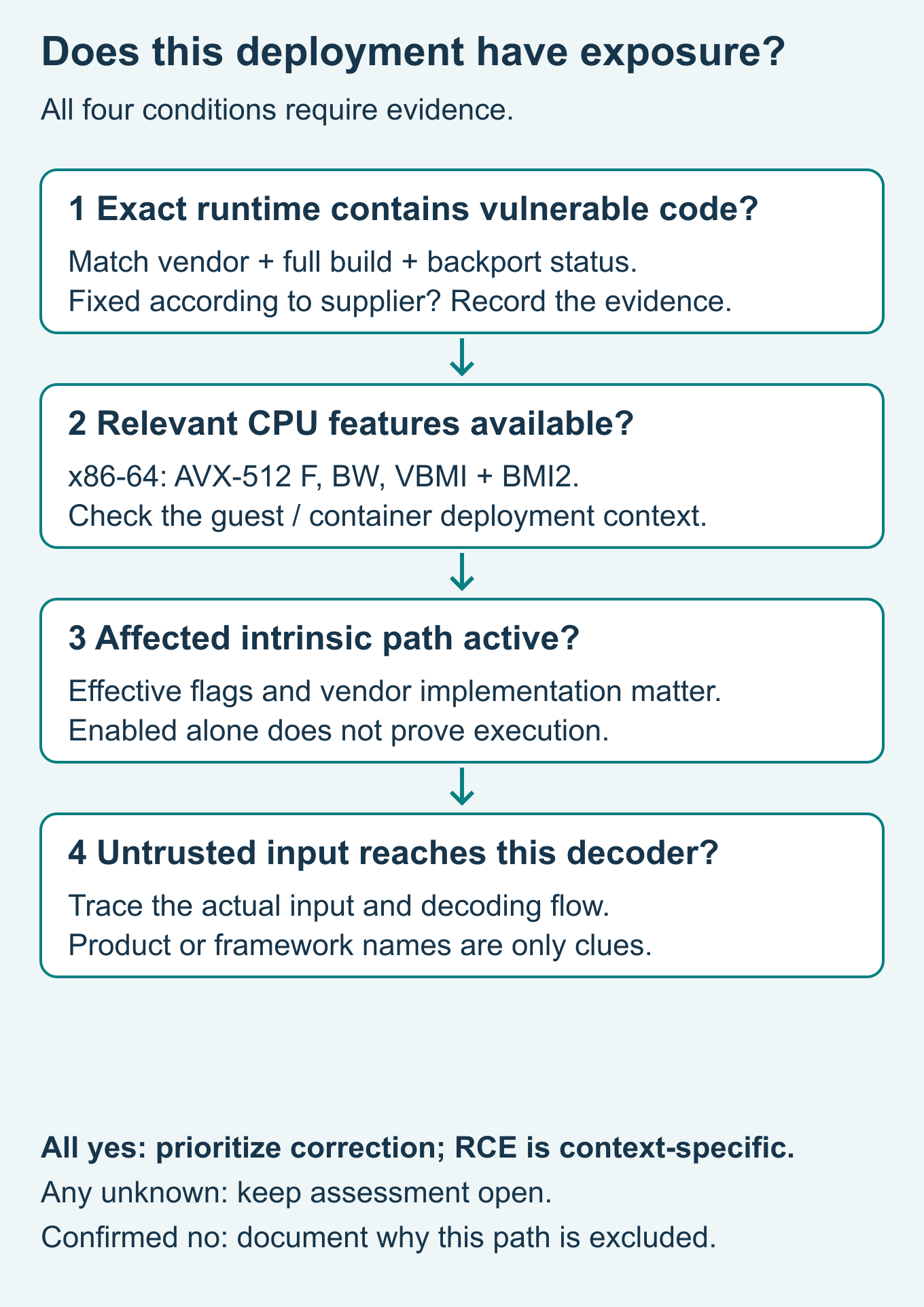
Use the following questions in order. An unanswered question means “unknown,” not “unaffected.”
| Question | Evidence to collect | Decision |
|---|---|---|
| Does the exact runtime include the vulnerable implementation? | Vendor, full build, package release, product advisory | A vendor-confirmed fixed build closes this version check. A major version alone does not. |
| Can this process use the relevant CPU instructions? | OS/architecture, guest-visible CPU features, deployment placement | Assess the environment visible to the JVM, including virtualization and scheduling constraints. |
| Is the affected accelerated implementation enabled? | Effective runtime flags, supported vendor defaults | Enabled does not prove a particular request uses it; disabled can establish a documented configuration mitigation. |
| Can untrusted data reach the relevant decoder? | Request flow, decoder implementation, authentication boundary | Trace the actual path. A framework or product name is only a starting point. |
CERT-EU identifies the x86-64 features avx512f, avx512bw, avx512vbmi and bmi2, together with an active intrinsic and attacker-controlled decoder input. Its examples include HTTP Basic authentication, JWT and SAML messages. ARM64 is outside this hardware-specific path. These are deployment conditions, not instructions to send malformed data. CERT-EU advisory
For Spring teams, inspect how requests reach decoding in the deployed stack. Updating a Maven dependency does not necessarily replace the Java executable in a container or appliance. Conversely, the presence of Spring Boot alone does not identify which decoder an endpoint uses. Our Spring Boot and Keycloak OIDC guide explains the authentication boundaries worth tracing; it is not a Java4Shell diagnosis of Keycloak installations.
Calif reports pre-authentication RCE demonstrations against Keycloak, Jira, Confluence, Artifactory, Jenkins and PingFederate, plus sample Spring Boot applications. Those demonstrations concern tested configurations; they do not establish the state of every installation. Research report
Do not turn a family name into a version verdict
The OpenJDK advisory's CVE-specific matrix marks 17, 21, 25 and 27, with empty cells for 8 and 11. Its introductory list covers the whole security release, not this CVE alone. OpenJDK matrix
Oracle separately lists Java SE 8u511b33-perf as affected. That performance build is the reason “Java 8 is always safe” is an incorrect cross-vendor rule. Oracle's other listed affected Java SE builds are 17.0.21.0.3, 21.0.13.0.3, 25.0.5.0.3 and 27.0.1.0.3. These are its supported affected versions, not a complete history of every vulnerable release. Oracle risk matrix, CVE-2026-114938
Temurin explicitly identifies its ordinary JDK 8 and 11 lines as unaffected. Keep that statement scoped to Temurin rather than generalizing it to special builds elsewhere. Adoptium guidance
2. Update availability: match the supplier and the delivery channel
The following is a research snapshot, not a universal minimum-version policy. “Published” refers to the cited release information; it does not mean every mirror, architecture, container tag or embedded product has received it.
| Supplier / product | Affected build scope | Confirmed correction or errata | Availability at research cutoff | Source |
|---|---|---|---|---|
| Oracle Java SE | Listed builds above, including 8u511b33-perf | November CSPU: 8u513; 17.0.21.1; 21.0.13.1; 25.0.5.1; 27.0.1.1 | Released 17 November; 17 release notes specify 17.0.21.1+4 | CSPU releases, 17 notes |
| Oracle GraalVM | For JDK: 17.0.21.0.3, 21.0.13.0.3; Enterprise: 21.3.20.0.3 | Exact fixed build not independently established here | Obtain product-specific patch instructions; do not substitute Java SE build numbers | Oracle matrix |
| Eclipse Temurin | Unpatched 17 from 17.0.6; 21, 25, 27; 8/11 unaffected per vendor | 17.0.21.1+2; 21.0.13.1+2; 25.0.5.1+2; 27.0.1.1+4 | Release in progress by platform; container publication follows completion of binaries for a JDK version | Adoptium, platform tracker |
| Red Hat build of OpenJDK / RHEL | Bulletin lists OpenJDK 17, 21, 25 and RHEL 8/9/10, subject to exposure conditions | No exact corrected package or RHSA established from the retrieved bulletin | Bulletin says fixes expedited; consult the current CVE product status and repository errata | Bulletin, CVE status |
| Corretto on Amazon Linux 2023 | Advisory-scoped java-17/21/25-amazon-corretto packages | ALAS2023-2026-3478 / 3479 / 3480 respectively | Advisories published 17 November; release channel 2023.12.20261117 | 17, 21, 25 |
| Azul Zulu | Vendor CVE table identifies 17/21/25/27 | CA PSU: Zulu 17.70.201 (17.0.21.1+2), 21.54.201 (21.0.13.1+2), 25.38.201 (25.0.5.1+2), 27.30.201 (27.0.1.1+4) | November CSPU published; SA CPU/PSU branches have separate identifiers | Release notes, version mapping |
| Microsoft Build of OpenJDK, BellSoft Liberica, SAP SapMachine | CERT-EU lists these OpenJDK distributions; exact affected build ranges not confirmed here | Unknown in this research snapshot | No verified distribution-specific fixed-build mapping obtained; check supplier channel | CERT-EU |
| Products with bundled runtimes | Depends on bundled build and exposure | Product-vendor update or supported mitigation | Unknown until checked for the particular product version | Red Hat product guidance |
For Red Hat packages, record the complete RPM version-release and architecture and match the applicable erratum. A backport can repair older upstream code without adopting the version string used by Oracle. Our assessment therefore does not label an RPM vulnerable merely because its upstream-looking number is below an Oracle correction. Red Hat backporting policy
Do not downgrade to an obsolete Java line to avoid this issue. Choose a supported, corrected runtime compatible with the product, then test the application on that runtime.
3. Temporary mitigation: a startup change with a verification step
Red Hat currently prefers -XX:-UseBASE64Intrinsics: it disables the accelerated Base64 implementation while retaining unrelated AVX-512 optimizations. Its alternative, -XX:UseAVX=2, caps AVX use and prevents the AVX-512 path. Red Hat warns that the x86-specific option can prevent ARM64 JVM startup. Red Hat mitigation guidance
| Startup option | Scope to confirm | What to test |
|---|---|---|
-XX:-UseBASE64Intrinsics |
Vendor-supported HotSpot option; Temurin recommends it for the affected implementation. Do not assume portability to every JVM. | Option recognition, startup, authentication and Base64-heavy workloads; loss of acceleration can affect throughput. |
-XX:UseAVX=2 |
x86-64 HotSpot alternative; not an architecture-neutral deployment default | Broader performance impact beyond Base64, supported CPU/VM configuration and startup compatibility. |
Temurin's guidance describes disabling the Base64 intrinsic as an interim measure. CERT-EU includes -XX:+UnlockDiagnosticVMOptions before that flag; Red Hat and Temurin show the flag alone. Preserve this source difference: test option acceptance with the exact vendor build and follow its instructions rather than distributing an assumed universal command. Temurin, CERT-EU
Operationally, adding an option to your interactive shell is insufficient if a service manager, wrapper or container entrypoint launches a different process. Put it in the supported startup configuration for the actual application, preserve existing heap, GC and agent settings, and check for conflicting options. In a mixed x86/ARM fleet, select the configuration by deployment architecture.
After the restart, confirm the process identity, runtime build and effective flag value. Keep a mitigation ticket open until the permanent update is deployed. Once every replica has a vendor-confirmed corrected runtime and functional checks pass, remove the temporary option through the same controlled rollout and verify again. Leaving it indefinitely can hide a performance cost and create configuration drift.
Microsoft describes Azure WAF protection as a supplement to patching. Treat network restrictions similarly: useful for reducing exposure, but dependent on traffic paths and inspection coverage. They do not repair the runtime. Microsoft WAF guidance
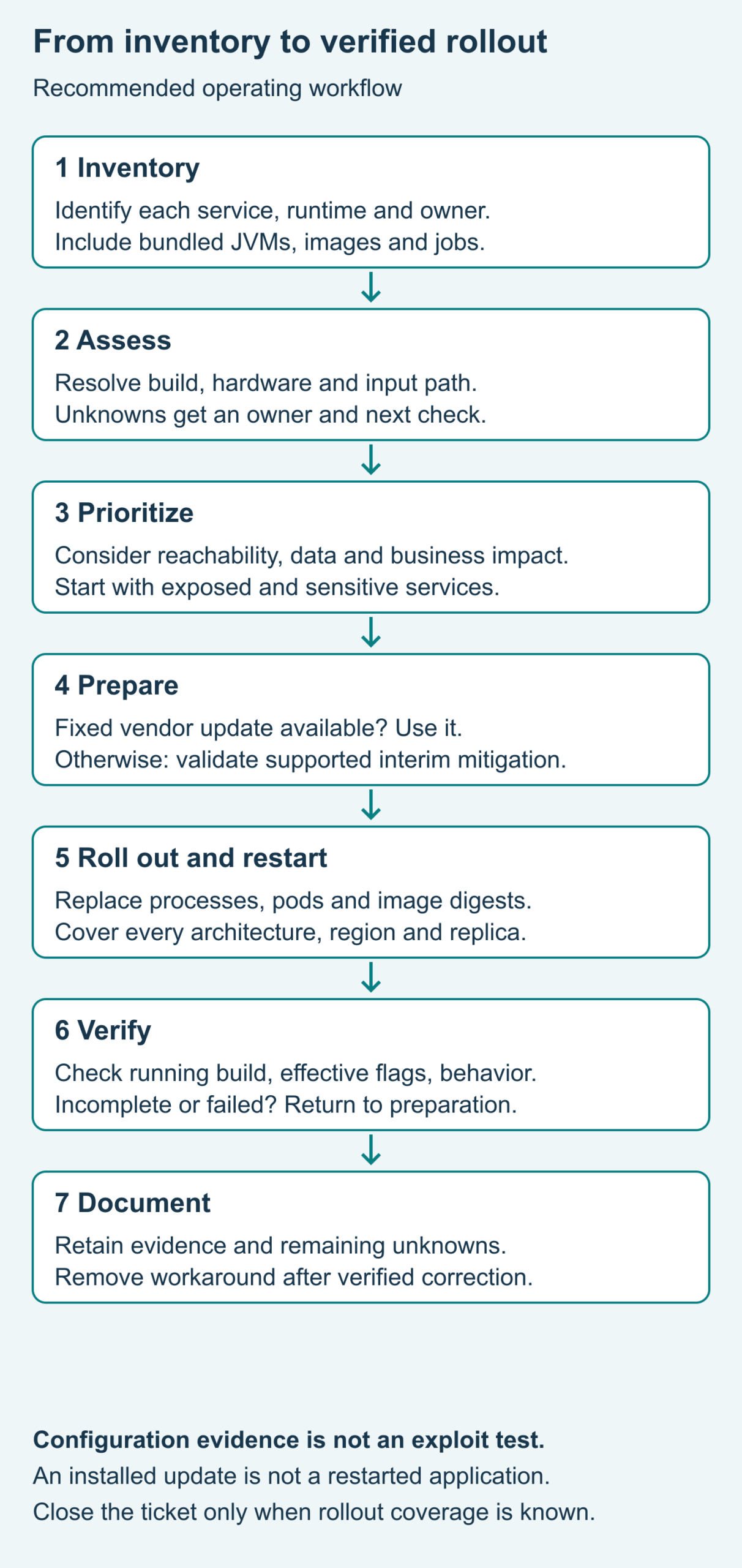
4. A practical rollout from inventory to evidence
The following is our recommended operating procedure. Adapt its execution to your existing change and incident process.
- Inventory. Assign an owner to each service. Record runtime vendor/build, executable path, product version, OS/architecture, deployment identifier, startup source and evidence time. Include scheduled jobs, clients, developer services and appliances with embedded Java.
- Assess. Resolve the vendor build status and hardware/decoder questions. Record “unknown” with an owner and next check when a bundled runtime cannot be inspected. Separate confirmed facts from assumptions about input reachability.
- Prioritize. Start with externally accessible, sensitive and high-impact services. Consider authentication boundaries and outbound processing of untrusted content. An internal deployment still needs an assessment.
- Prepare the correction. Select the product-supported update. If unavailable, validate a documented workaround on a representative non-production deployment. Preserve the old configuration for operational rollback; reverting to an affected runtime also restores its security exposure.
- Restart or roll out. Rebuild custom container images with the corrected runtime, pin the new digest and replace running instances. A new base image does not change an existing pod. Check all replica sets, node architectures, regions, background workers and jobs that may launch later.
- Verify. Match each replacement process to the intended build and image digest. Check effective flags and application behavior. Compare errors, latency and resource use with your normal baseline. A readiness check alone does not establish patch status.
- Document. Retain vendor evidence, build/package identifiers, process start time, configuration result, rollout coverage, owner and unresolved checks. Record removal of a workaround as a separate completed change.
For systemd services, inspect the unit, overrides and any wrapper's documented options before editing anything. Do not replace an entire ExecStart or JAVA_TOOL_OPTIONS value with a single security flag. For Windows services, inspect the registered executable and the product's service wrapper; the java found in PowerShell may be unrelated. For embedded runtimes, let the product supplier define whether independent JVM replacement is supported.
5. Safe checks: observe the process you intend to assess
These examples are for your own authorized environment. They request inventory or diagnostic output; they do not submit attack input. Diagnostics can still have operational overhead. Use your normal access controls and keep raw command lines private because they may contain secrets.
Linux with systemd: identify a service first
Replace example.service with the actual unit. Service visibility and /proc access depend on local permissions. The following commands do not edit the unit or restart it:
systemctl show example.service --property=MainPID --property=ExecStart --property=Environment
systemctl cat example.service
Use the returned PID only after confirming it belongs to the Java process rather than a launcher. Then inspect its executable; 1234 below is a placeholder:
readlink /proc/1234/exeThe service manager exposes configuration and process metadata; it does not establish the values the JVM ultimately accepted. See the systemctl documentation. A host package update can leave an old process running, so also retain restart evidence.
Linux CPU check: establish potential hardware exposure
Red Hat provides this read-only check for the CPU feature exposed to the Linux host or guest VM. It normally needs no elevated privileges, provided /proc/cpuinfo is readable:
grep -o avx512vbmi /proc/cpuinfo | head -1If it prints avx512vbmi, that is positive evidence that the inspected host or VM exposes the relevant AVX-512 VBMI feature. It establishes the hardware condition for potential exposure described by Red Hat. Run it in the environment where the application executes: a physical host's CPU model does not establish which features a guest VM exposes. Red Hat detection guidance
Red Hat describes systems without that feature as not known to be affected by this path. Before interpreting no output, confirm that the file was readable and the command completed without an error; missing or restricted CPU information is unknown. The check does not identify the application's JVM build, prove that its intrinsic is active, or establish that untrusted data reaches the decoder. Combine this hardware evidence with those checks rather than treating it as a complete application verdict.
HotSpot diagnostics: inspect effective values
Use the matching JDK's jcmd, a confirmed PID and the same effective user/group as the target process. Container PID namespaces and disabled attach mechanisms can prevent access. Do not change attach security settings just to make a check pass; record unavailable evidence. Oracle documents these commands as low-impact diagnostics. jcmd reference
/path/to/matching-jdk/bin/jcmd 1234 VM.version
/path/to/matching-jdk/bin/jcmd 1234 VM.flags -all
Read the full runtime/build output, then look for the effective values of UseBASE64Intrinsics and, on x86, UseAVX. A false Base64-intrinsics value supports the documented configuration mitigation for a matching affected HotSpot build. A value of UseAVX at 2 or lower supports the x86 cap. A true Base64 flag does not prove that the vulnerable machine-code path is executing. Missing flags, an attachment error or ambiguous output leave this check unknown.
java -version and java -XX:+PrintFlagsFinal -version start or inspect a different JVM invocation. They can help identify a selected executable or test flag recognition, but do not verify the already running application. Likewise, text in a launch script is intended configuration, not effective-state evidence.
Optional offline capture reader
The accompanying capture reader and tests (ZIP) summarize the two relevant values from a saved VM.flags -all output. The reader reads a local file only, makes no network requests, performs no attach operation and never returns a “safe” verdict. It reports unknown for missing or conflicting evidence. It does not classify vendor builds or CPU features.
python read_flags.py saved-vm-flags.txtThe script and tests are available in the editorial package. Its fixture tests check parsing behavior, not this vulnerability, a patched JVM or the security of a real deployment. We did not run these service commands against a local or production application during article preparation.
6. What failed beneath Java's memory-safety boundary?
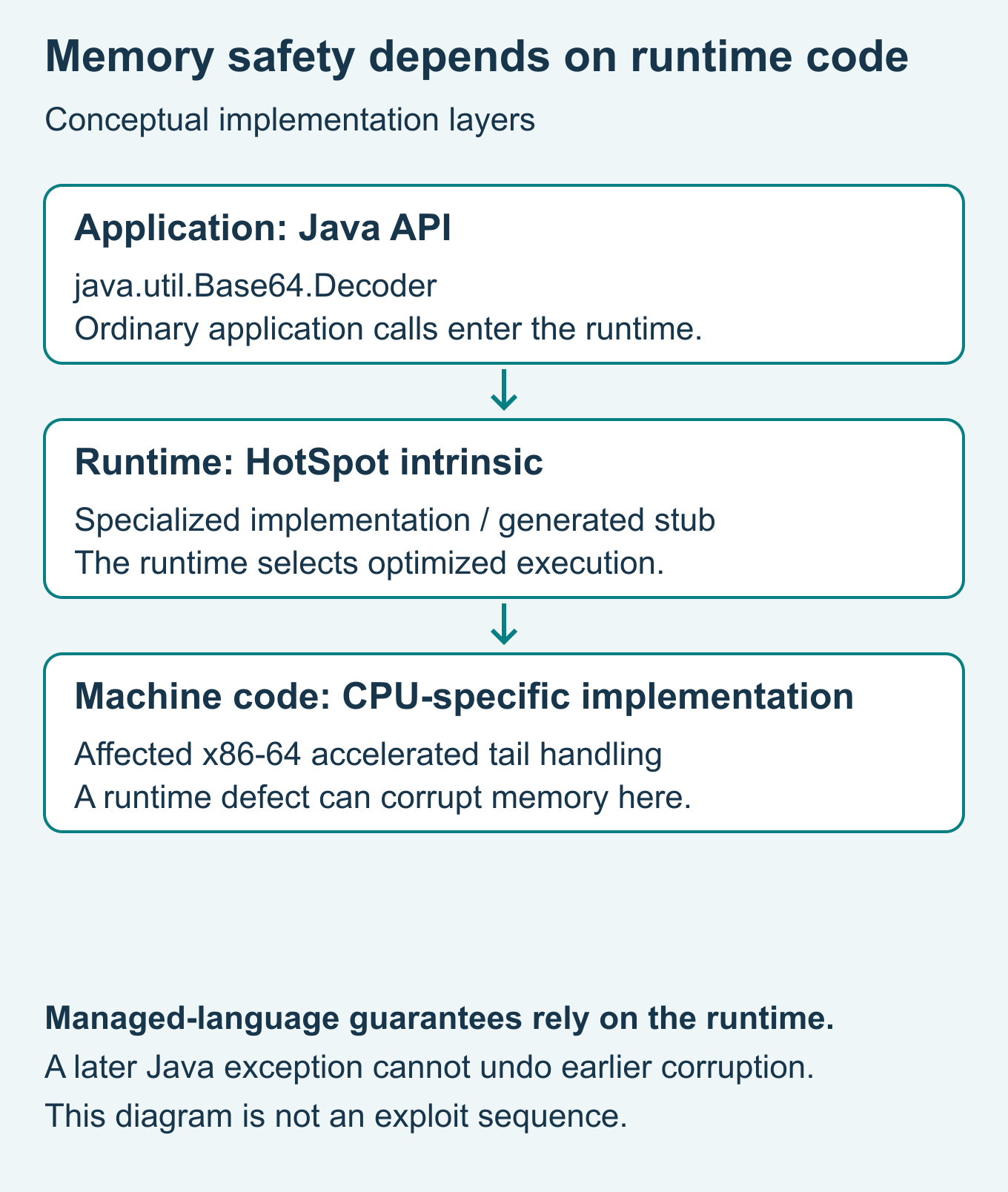
java.util.Base64.Decoder is the Java API an application calls. HotSpot can replace selected operations with an intrinsic: a specialized implementation used by the runtime/compiler. That implementation can execute generated machine code rather than the ordinary Java method body. The relevant boundary is therefore application API → HotSpot optimization → CPU-specific code.
Calif locates the bug in the x86-64 intrinsic's assembly tail handling. A length calculation underflows, producing an incorrect store mask and an out-of-bounds write. Java's later rejection of invalid input cannot undo the earlier memory corruption. Technical report
Java's managed references and bounds checks protect operations implemented under those rules. They depend on the correctness of the runtime implementing them. A defect in specialized runtime machine code can violate that boundary even when the application's own source uses ordinary Java APIs. The OpenJDK advisory accordingly classifies this CVE under hotspot/compiler. OpenJDK advisory
A crash is an availability failure. Disclosure additionally requires a way for affected memory to become observable. RCE requires a workable application-specific chain beyond the initial corruption. These are distinct outcomes, not interchangeable descriptions of every decoder invocation. Microsoft's summary includes all three as potential consequences. Microsoft
A concrete attack scenario: an invoice API behind HTTP Basic
Consider a fictional deployment, not a customer incident: an invoice service exposes GET /api/invoices over HTTPS. Its authentication handler reads the HTTP Basic header, decodes the credentials with java.util.Base64.Decoder, and only then checks the password. Assume the operator has separately confirmed an unpatched affected HotSpot build, the required x86-64 CPU features and an active vulnerable intrinsic.
The input path is plausible: Red Hat identifies HTTP Basic credentials as a source of attacker-controlled Base64 processed before authentication. Its updated product guidance also explicitly says a Keycloak login requirement does not protect an affected instance. That product statement does not prove that every invoice API or Spring Security configuration uses the same path. Red Hat bulletin
- An unauthenticated attacker can submit requests to the endpoint and control the Basic header's encoded credential value. A valid account is not required to reach this fictional handler's decoder.
- If a suitably malformed value reaches the affected accelerated implementation, the runtime defect can corrupt memory before the application finishes rejecting the credentials.
- A crash is one possible outcome. Disclosure additionally needs an application-specific route for affected memory to become observable; code execution needs further application-specific exploitation. Neither follows automatically from a
401response or a successful CPU-flag check. Microsoft impact summary
For the operator, the important boundary is decoding before authentication. A dashboard full of rejected logins does not establish that the decoder was never reached. It also does not establish an attack: routine invalid credentials can produce the same status. Investigate process crashes and other anomalies through the normal incident-response process rather than diagnosing Java4Shell from HTTP status codes alone.
Run a harmless illustration of that boundary
Download the Java authentication-boundary demo (ZIP). It models that control flow offline; it is not a Spring application, a network server or a Java4Shell PoC. It uses one short, valid Base64 value representing demo:wrong-password. It accepts no target or arbitrary payload and does not send a request. Use a Java 17+ HotSpot JDK that recognizes the flag below; no affected runtime is needed.
After extracting the archive, run in its directory:
javac AuthBoundaryDemo.java
java -XX:-UseBASE64Intrinsics AuthBoundaryDemo
java -XX:-UseBASE64Intrinsics AuthBoundaryDemo --test
The demo disables Base64 intrinsics as a precaution. If the JVM rejects the option, stop and consult that vendor's documentation. The relevant output is:
request_received
base64_decoder_called
credentials_checked
authentication_rejected
simulated_http_status=401
The program was compiled and executed, and six control-flow assertions passed. The trace demonstrates that decoding occurs before a failed authentication in this example. It does not demonstrate memory corruption, a vulnerable JIT path, disclosure, RCE, or the behavior of your deployed framework. The simulated HTTP status is printed by the program; no HTTP exchange occurs.
Updating the runtime or applying the documented intrinsic workaround addresses the vulnerable implementation path. Ordinary credential decoding can still occur before authentication afterward. Therefore, the same harmless trace is expected even with a corrected runtime: it explains the boundary, not whether a patch works.
Why the severity numbers differ
Oracle and OpenJDK publish CVSS 3.1 8.1, with high attack complexity in their network vector. Red Hat's CVE page displays Critical / CVSS 3.0 9.8, with low attack complexity in its displayed vector. Calif reports CVSS 4.0 9.2 / Critical. These are source-specific assessments with different assumptions and, for Calif, a different CVSS generation. Do not average them or treat the largest number as an installation diagnosis. Oracle, OpenJDK, Red Hat CVE, Calif
7. Did OpenAI discover it?
The supported attribution is: Calif researcher Quang Luong identified the vulnerability with help from OpenAI Codex. He describes directing the audit and rejecting unrealistic findings. The report names Codex, not an underlying model. Original account and credits
Oracle credits both Quang Luong of Calif.io and Albert Yang for this CVE; OpenJDK also acknowledges both among its contributors. That official credit is broader than the discovery narrative alone. It does not establish discovery by OpenAI as an organization. Oracle credits, OpenJDK acknowledgements
There are separate responsibilities here: a researcher directs and evaluates the investigation; an AI tool assists it; maintainers and vendors produce and distribute corrections; operators establish that corrected code is running. None can be replaced by saying “AI found it.” We omit unverified model names and do not turn the team's reported timing or token expense into a general productivity promise.
Calif publishes a bounded trigger PoC while withholding product-specific exploit chains at the research cutoff. A published PoC, a research demonstration and confirmed exploitation in the wild are different evidence categories. Sophos says it is unaware of public in-the-wild reports at its 18 November update. That is a time-limited vendor statement, not evidence that exploitation has not occurred. We have no independent confirmation of active exploitation. Calif PoC status, Sophos advisory
8. What software teams should retain
Runtime ownership belongs beside dependency ownership. A useful inventory can answer “which Java process is serving this request?” and “which supplier confirms this build is corrected?” without reconstructing the deployment under pressure.
AI-assisted security research can accelerate discovery in a documented case. This case does not establish that an agent will outperform every audit method or validate its own findings reliably. Human evaluation, coordinated disclosure and verified remediation remain separate work. For a broader treatment of responsibility and evidence in agent workflows, see our AI-agent architecture decision guide.
For the current incident, close the operational loop: vendor evidence, deployed build, replacement process, effective configuration and coverage across the fleet. An update downloaded to a host is only one step in that chain.
Sources, retrieval status and update notes
All sources below were checked on 18 November 2026; the research cutoff at the top gives the final recheck time. Links beside claims point to the relevant authority. The local research ledger records retrieval methods and limitations.
| Source | Source update information / research note |
|---|---|
| Red Hat bulletin and CVE record | Bulletin displays 17 November 17:14 without an explicit timezone; CVE record displays 18 November 01:48:41 UTC; its statement still contains earlier upstream uncertainty despite Oracle’s published update. Distinct records, not one synchronized release feed. |
| OpenJDK advisory | Last update displayed: 17 November 17:44 UTC. Web retrieval failed; full advisory read in browser, including CVE-specific cells. |
| Oracle CSPU, release list, 17 release notes | 17 November release. Public advisory read; restricted support patch documents not inspected. |
| Calif | Original report read in browser after web retrieval failed. No explicit last-modified time observed. Product demonstrations are researcher reports, not our reproduction. |
| Adoptium | Dated 18 November; browser access succeeded after web-tool failure. Platform publication still in progress. |
| Amazon Linux 2023 advisories and Azul release notes | Dated 17 November. Package/channel scope retained; no claim that embedded products are simultaneously updated. |
| Microsoft Azure guidance | Dated 17 November, version 1.0; read in browser. WAF guidance is not a Microsoft OpenJDK fixed-build announcement. |
| CERT-EU and Sophos | 18 November advisories. CERT-EU release 09:11:05, timezone unspecified on page; Sophos version 1. |
Change note — 18 November 2026: Initial article includes the Oracle Java 8 performance-build exception, supplier-specific availability, startup-flag differences and limits of configuration evidence. Later additions clarify the Linux CPU check and add a fictional Basic-authentication attack scenario with a tested, harmless Java control-flow demo. Red Hat's bulletin was rechecked for the scenario and now displays an 18 November 10:30 update (timezone unspecified), including Keycloak guidance. The supplier table above retains its original research cutoff; this addition is not a fresh audit of every distribution's release status.