A town has €12 million to invest. Its school needs renovation, a river district faces flood risk, and residents without cars want a dependable bus service. Each project has a convincing advocate. Each uses different evidence. Each leaves someone waiting.
An AI system could read the engineering reports and consultation responses. A blockchain could record which documents were registered before the council meeting. Neither can decide how much the town should value a child's learning conditions relative to a household's flood exposure or an older resident's independence.
Better evidence can improve a decision without settling what the decision ought to be. The useful question is how technology can make the evidence, interests, assumptions and exercise of authority easier to examine and challenge.
Research checked on 17 November 2026. The town, budget, projects, scores, weights and pilot targets below are fictional, illustrative assumptions. The proposed architecture has not been deployed or evaluated. Research findings and documented applications are identified separately; none establishes the superiority of a combined AI/blockchain system.
1. Why informed, well-intentioned people still struggle
Herbert Simon's 1955 model of rational choice challenged the assumption that people can examine every alternative and consequence. We search with limited time, knowledge and processing capacity, often stopping when an option meets an acceptable threshold: satisficing. A council member reading hundreds of pages after work illustrates the problem; it does not establish incompetence.
Other mechanisms matter too. Confirmation bias means selectively seeking or interpreting evidence that fits an existing belief. Motivated reasoning goes further: a desired conclusion can influence which memories, arguments and standards of proof we use. Ziva Kunda's research review explains how motivation can shape reasoning without requiring conscious dishonesty.
The presentation of an option can change its appeal. Tversky and Kahneman's framing experiments showed preference shifts between differently worded versions of decision problems. Their prospect theory paper models outcomes relative to reference points, with losses typically carrying greater weight than corresponding gains in its value function. This is not a universal numerical rule about every person or political question.
Groups can also miss what their members know. In Stasser and Titus's experiments, discussion favored shared information over information held by individual members. Asch's conformity studies showed that unanimous social pressure can influence judgments even in simple perceptual tasks. These findings identify mechanisms, not a diagnosis of every committee. “Groupthink” is a useful warning about suppressed challenge, but not an explanation to attach automatically to any agreement we dislike.
Institutional incentives influence attention as well. An elected official may care about reelection; a department about its budget; a contractor about revenue; an employee about career risk. A visible opening ceremony can be easier to reward within an electoral or reporting cycle than maintenance whose benefit is an avoided failure. Buchanan's public-choice perspective asks how individual interests interact with collective rules. It is an analytical lens, not proof that public servants act only selfishly. Public service, solidarity and professional duty can coexist with personal incentives.
The same scrutiny belongs on experts, developers and technology suppliers. An analyst may prefer familiar models; a platform vendor may favor measures that make its product look successful. Publishing a conflict does not eliminate it, but makes evaluation more informed.
| Human factor | Possible technical help | Remaining limit |
|---|---|---|
| Limited attention and expertise | Searchable documents, plain-language explanations and source-linked briefs | Someone still selects sources and decides what deserves attention |
| Confirmation bias and motivated reasoning | Request counterevidence and record unresolved objections | The prompt, corpus and reviewer can share the same bias |
| Framing and loss aversion | Present equivalent descriptions, reference points and consequences side by side | Choosing a frame and baseline is itself consequential |
| Career, budget and short-term incentives | Disclose interests; compare commitments with later outcomes | Disclosure does not change incentives or prove corruption |
| Conformity, groupthink and selective sharing | Collect independent views before discussion; maintain a dissent register | People can still self-censor or fear retaliation |
| Information asymmetry and unequal access | Publish usable evidence; offer translation and assisted participation | Time, digital access, literacy and influence remain unequal |
| Uncertain long-term interactions | Explore ranges, dependencies and alternative scenarios | A model can omit mechanisms or use mistaken assumptions |
The technical responses in this table are design proposals informed by these mechanisms, not experimentally established cures.
Four distinctions keep the analysis fair. Wanting a bus route near one's home is a legitimate interest; concealing a financial stake or falsifying evidence is different. Not knowing the flood probability is an information gap; disagreeing about acceptable risk is a value conflict. A mistaken cost estimate is an error; consciously accepting a higher cost to protect a vulnerable group can be a defensible tradeoff. “This route serves 800 daily trips” is empirically testable; “equal access deserves priority over maximum passenger numbers” is normative. Data can inform the latter without deciding it.
2. Participation, deliberation and power are different things
A public consultation collects contributions. A deliberative process gives participants time, balanced information and opportunities to question one another. An administrative decision applies public authority to a case or service. A parliamentary decision exercises legislative or budgetary authority under an institutional mandate. A binding election determines an authorized result under its own eligibility, secrecy, integrity and oversight requirements.
An effective tool for one is not automatically suitable for another. Summarizing consultation responses is a different task from deciding eligibility for a benefit or counting binding votes. A corporate investment committee can use a similar evidence process, but its authority comes from organizational rules. It cannot inherit the mandate of an elected council merely by running a consultation.
Two illustrative transfers make the boundary concrete. A business choosing between equipment maintenance and expansion could use AI to compare incident reports, demand assumptions and supplier interests; management still owns the investment and its effects on employees. An administration preparing a transport plan could use AI to organize consultation evidence and flag inconsistent accessibility claims; authorized officials still own the proposal, review and response to objections. Neither example licenses a model to make binding individual decisions.
Participation is also not representativeness. An open website mainly reveals the people who chose and managed to use it. A statistically informed recruitment process can improve coverage, but selection and nonresponse still matter. Counts of messages cannot be treated as population support. The OECD's 2025 emerging-technologies report starts with participation challenges rather than a technology shopping list; institutional connection, capacity and process design matter alongside tools.
For our town, publish who may contribute and how contributions affect the decision. Offer paper, telephone and supported in-person routes alongside digital participation. Provide accessible formats, interpretation and practical help with attendance. Separate an open consultation from a recruited deliberative panel and report each distinctly. Report coverage gaps, not just total submissions.
Identity checks should match the task. A confidential suggestion may not need the same verification as a resident budget ballot. Stronger checks can deter some coordinated repeat participation while excluding residents who lack the required documents or confidence. Separate identity records from public opinions; provide an appeal when duplicate detection makes a mistake. Similar wording can reveal a campaign, not necessarily fake people. Coordinated advocacy should be labeled and examined rather than silently deleted.
Democratic legitimacy needs authorized decision makers, fair procedures, public reasons and independent checks. A majority preference cannot by itself settle minority protections or remove applicable rights. A consultation must state what remains open to influence, what constraints apply, and how the institution will respond to proposals it rejects.
3. What AI can help with—and what the evidence actually shows
The OECD's 2026 report, Artificial Intelligence and the Future of Citizen Participation, published on 30 June, maps 50 use cases across 22 member and partner countries. Its applications include information preparation, sense-making, translation, moderation, facilitation and simulation. A map of uses demonstrates adoption and possible roles; it is not a controlled demonstration of better public decisions.
There is more focused experimental evidence. In Tessler and colleagues' 2024 Science study, involving 5,734 participants, people preferred group statements generated by an AI mediator to those written by human mediators, rating them more favorably for clarity, informativeness and lack of bias. The study also examined incorporation of dissent and replicated findings in a virtual citizens' assembly with a demographically representative UK sample. These are encouraging results for mediated statements in the studied settings. They do not show better infrastructure investment, long-term welfare or electoral legitimacy. Several authors developed the system: independent replication and deployment evaluation remain valuable.
Consider a documented application too. Taiwan's Ministry of Digital Affairs describes the use of Polis in the 2015 Uber case. Opinion clustering can help locate patterns across groups within a wider facilitated process. Polis should not be confused with a modern generative chatbot. The institutional account documents a real process; it is not a causal estimate that the software improved policy quality or that all citizens were represented.
Counterevidence sharpens the design. Jungherr and colleagues' 2025 study found lower willingness to participate and lower anticipated quality for AI-facilitated than human-facilitated deliberation. This concerns reactions to described formats, not an observed decline in the quality of every deployed process. It nevertheless warns against assuming that automation makes participation more welcoming.
The DeliberationBank study, revised in March 2026, evaluates opinion aggregation using human-grounded data and reports weaknesses including underrepresentation of minority positions. Its benchmark is not a municipal outcome study. Read together, the studies suggest that a fluent common-ground statement needs separate checks for what it leaves out.
For the town, AI could build a claim-and-evidence map: which report supports each cost, which passage states an assumption, which residents contest the interpretation, and what evidence is missing. It could translate contributions, draft accessible explanations, compare project variants, identify affected groups and flag contradictions between goals and proposed measures. A promise to improve evening access, for example, should trigger a question when the proposed bus timetable ends before evening shifts finish.
Every consequential factual statement should open onto the relevant passage and document version. Reviewers must check that the passage supports the claim, not merely that a link exists. Unavailable evidence should remain unavailable, rather than being filled with a plausible sentence. Readers who want the underlying terminology can use our neural networks, machine learning and LLM guide.
4. The town's budget: make assumptions visible before scoring
Here is our fictional starting brief. The €12 million is a capital envelope; recurring costs need a separate funding decision. All amounts and descriptions in the following example are invented teaching assumptions, not estimates for a real municipality.
| Project | Illustrative capital cost | Affected groups and interests | Known, uncertain or contested in the fictional brief |
|---|---|---|---|
| School renovation | €7m | Pupils, staff, parents, future pupils, construction firms | Condition survey available; disruption and final tender cost uncertain; scope disputed |
| Flood protection | €8m | River residents, tenants, businesses, upstream and downstream communities | Hazard study available; future rainfall and avoided losses uncertain; distribution of protection contested |
| Bus access improvements | €5m | Non-drivers, commuters, older and disabled residents, operators | Existing timetable and counts available; future demand and operating subsidy uncertain; route priorities disputed |
The cost assumptions allow school plus bus improvements at €12m; flood protection plus either full alternative exceeds the envelope. That does not make flood protection irrational. The council could examine phased works, a narrower school scope, grants or a different financing timetable. Those are new alternatives to investigate, not free savings the AI can assume.
First check mandatory obligations, feasibility and minimum safety requirements through qualified review. A safety obligation is not simply another preference that a weighted score may trade away. Then compare feasible options using explicit criteria, including who benefits and who bears disruption. Keep source uncertainty separate from disagreement over values.
To illustrate sensitivity only, imagine each project has an invented 0–10 rating on three criteria: learning conditions, flood resilience and everyday mobility. School receives (9, 2, 3), flood protection (2, 9, 2), and bus improvements (3, 2, 9). These ratings are fabricated, treated as comparable for this exercise and deliberately omit important impacts, costs and interactions.
| Illustrative priorities: learning / resilience / mobility | School index | Flood index | Bus index |
|---|---|---|---|
| 60% / 20% / 20% | 6.4 | 3.4 | 4.0 |
| 20% / 60% / 20% | 3.6 | 6.2 | 3.6 |
| 20% / 20% / 60% | 4.0 | 3.4 | 6.4 |
Each index is the sum of a rating multiplied by its weight. The arithmetic is reproducible; the ratings and priorities are not objective facts. This is a comparison of individual project profiles, not a portfolio optimizer or a recommendation for allocating €12m. Adding indices for school and bus would require justified assumptions about shared benefits and double counting. Small numerical differences should not be presented as meaningful precision.
The useful result is the reversal: changing priorities changes which profile scores highest. Ask who approved the criteria, whether a criterion is missing, and whether reasonable changes to ratings also reverse the result. No extra model training can decide the proper weight of intergenerational fairness.
AI can help explore scenarios, while validated calculation tools perform the arithmetic. A flood scenario is conditional on hazard, exposure and engineering assumptions; a transport scenario on demand and service assumptions. A simulation is not a prediction. Review ranges and failure cases, including reduced benefits, cost overruns and delayed delivery. Do not present a model's generated narrative as a calibrated probability.
5. Corrections and dissent belong in the process
Suppose a resident notices that the bus summary excludes wheelchair access. A transport specialist finds an outdated ridership table. A downstream group argues that the flood proposal transfers risk. Each objection needs an identifier, the exact claim challenged, evidence where available, an assigned reviewer and a visible resolution status.
In our proposed process, reviewers can accept a correction, reject it with reasons, request more evidence or retain a genuine unresolved disagreement. Publish the corrected brief alongside a change notice explaining which conclusions moved. Notify affected contributors through their chosen contact channel where appropriate. If a factual revision changes feasibility or a major tradeoff, reopen the relevant deliberation rather than silently replacing the recommendation.
Maintain a separate minority-position register: the position, its reasons, affected people, supporting evidence, unresolved concerns and the institution's response. Do not force every disagreement into one compromise paragraph. Let contributors check whether the summary fairly represents them; that does not give any one contributor a veto over everyone else's account.
The council makes the final budget decision in this fictional governance model. It publishes its reasons, approved criteria, rejected alternatives and handling of objections, including where it consciously departs from an analytical ranking. Named officials own implementation. Independent reviewers can examine evidence and procedure, and residents have a documented complaint route. Formal legal remedies depend on the jurisdiction and type of decision; this proposal does not invent a universal right of appeal.
Before approving expenditure, specify later checks: school condition and disruption, flood-model assumptions and observed performance, bus accessibility and actual service use, delivery cost and distribution of benefits. Record a baseline and suitable comparison where feasible. A quiet flood season does not alone prove that a barrier worked, just as higher ridership does not alone establish that the new infrastructure caused it. Publish adverse findings and the decision on corrective action.
6. AI risks can change the politics of the process
The NIST Generative AI Profile identifies risks including confabulation, harmful bias, information integrity, information security and human–AI configuration. Retrieval does not guarantee completeness; a model can cite a genuine document for a claim it does not support. Missing data and biased records can make polished output misleading. Reviewers may also defer to confident language.
Our design response is to treat submitted material as evidence to inspect, never as operational instructions. A malicious contribution might tell the model to ignore opposition or reveal private records. Restrict retrieval and tools, isolate identity data, test such attacks, and require human approval before publication. Keep the analysis system unable to approve expenditure or alter official criteria.
Summarization is an exercise of editorial power. Labeling a proposal “efficient modernization” rather than “service reduction” can change the frame. Publish editorial rules, show original contributions subject to privacy constraints, and make omissions challengeable. Avoid optimizing summaries solely for agreement or satisfaction.
Several agents do not guarantee several independent perspectives: shared models, training, source selection and prompts can produce correlated errors. Assigning one agent a “critic” role is a review technique, not evidence of independent scrutiny. Include people with distinct expertise, affected experiences and institutional independence.
Nor does formal optimization escape politics. Choosing an objective, time horizon, discount rate or fairness constraint changes the answer. Better measurement may narrow an empirical dispute while leaving a principled disagreement intact. Decision support becomes an exercise of power when a system effectively fixes the agenda or makes an unreviewable recommendation. A human signature is insufficient if that person lacks time, information or authority to challenge it.
7. What blockchain adds—and the simpler alternatives
A blockchain is a replicated ledger whose participants follow rules for accepting and ordering records. NIST's Blockchain Technology Overview describes tamper-evident and tamper-resistant properties. These depend on operation, validation and governance; “immutable forever” is too strong. Protocol changes, forks, collusion or compromised keys can change the assurance story.
Ledger consensus concerns the accepted register state. It is not social agreement, a democratic mandate or a test of truth. The oracle problem is the gap between external events and what enters the ledger: a perfectly recorded inspection can still be false. Validators, administrators, access rules, key recovery and upgrades all require accountable governance.
A hash is a compact fingerprint of particular bytes. Comparing it with a trusted prior commitment can reveal a change. A hash alone proves neither who created a document nor whether it is true or complete; a timestamp adds timing evidence under the timestamp mechanism's assumptions. Even a model identifier in a ledger does not prove that the recorded model actually produced the recommendation.
For foundational explanations rather than this article's governance focus, see Blockchain for Beginners.
| Need | Ordinary database and publication | Signed audit log or signed documents | When blockchain might add enough value |
|---|---|---|---|
| Check document versions | Version history, public releases and independent archives often suffice | Sign version manifests; optionally timestamp and mirror them | Multiple institutions need a shared record without one controlling the accepted history |
| Record evidence and model versions used | Store a decision bundle with source snapshot, model/configuration identifiers and approvals | Sign bundle hashes and release receipts; preserve actual outputs | Institutions need joint acceptance and ordering of bundles; it still cannot prove truthful execution |
| Track promised rules and changes | Publish criteria, change notices and approval minutes | Signed append-only entries can expose later alteration | Several authorities must jointly authorize rule transitions and resist unilateral rewriting |
| Maintain an interinstitutional register | A governed shared database may be cheaper and clearer | Independent witnesses can monitor signed checkpoints | Independent writers genuinely need shared validation, with funded operation and an agreed dispute process |
These are architectural judgments, not measured comparative results. A single municipality with an accepted records office usually has no demonstrated need for blockchain for these tasks. Public release, signed files and independent archives may answer the actual threat more directly.
An ordinary database offers flexible queries, access controls, corrections and deletion, but its administrator may be able to alter history unless other controls expose this. A signed document authenticates a signer's commitment under key and certificate assumptions; it does not ensure that every relevant document was released.
A cryptographic append-only log can provide inclusion and consistency proofs. Certificate Transparency's RFC 9162 is a concrete technical example of signed Merkle-tree logs, not a ready-made civic decision system. A civic adaptation needs monitors and independent witnesses to detect omissions or inconsistent views; signatures alone do not prevent a log operator showing different histories to different people. A blockchain changes how the shared history is agreed, while adding validator, consensus, recovery and operating costs.
Before selecting it, specify the attacker, distrust relationship and verification requirement. Who could rewrite which history? Who would detect it using the simpler design? Which additional attack does the ledger stop? If those questions have no concrete answer, its cost and complexity lack an adequate justification.
8. Privacy, tokens and elections need separate safeguards
Keep personal citizen contributions off a public blockchain by default. Timing, addresses, links and document fingerprints can reveal participation patterns or permit linkage. Hashing predictable material can allow guessing; hashing is not automatic anonymization. Store restricted originals separately with purpose, access and retention controls, and assess even the proposed public commitments before release.
For the EU/EEA, the EDPB's final Guidelines 02/2025, version 2.0, adopted 7 July 2026, address blockchain-specific data-protection risks. Under the EU GDPR, Articles 5 and 25 require, among other things, data minimization, storage limitation and protection by design. A ledger does not suspend these obligations. The deployment needs a jurisdiction-specific assessment of lawful processing, roles, rights, retention and any required impact assessment; this is not a legal compliance determination.
If a decentralized autonomous organization (DAO) enters the discussion, distinguish governance rights under its rules from civic authority. Token-weighted voting distributes influence according to token holdings, potentially concentrating it among wealthy holders, insiders or delegates. It may suit some voluntary arrangements, but a token balance is not a democratic mandate. Changing the label from council to DAO does not establish political equality, territorial representation or minority protection.
Binding elections deserve a separate security analysis. Park, Specter, Narula and Rivest's peer-reviewed research explains why blockchains do not solve the central problems of internet voting and can introduce further risks. A ledger cannot repair malware that changes a ballot before submission or eliminate coercion at home. Ballot secrecy, eligibility, availability and verification must work together.
The US National Academies' independent assessment likewise rejects decentralization as a substitute for election security. A multi-agency US risk assessment redistributed in 2024 distinguishes electronic delivery and marking from the high risks of electronic ballot return. These sources have different dates and scopes; none is a universal legal ban, and they do not establish that every remote-voting design is identical. No independently validated evidence located for this article justifies presenting blockchain as an automatic route to safe online elections. This article's pilot excludes binding voting.
9. A proposed architecture with named responsibilities
The following is our architecture proposal, not a documented production system. It puts responsibility around the tools rather than letting a platform define the process invisibly.
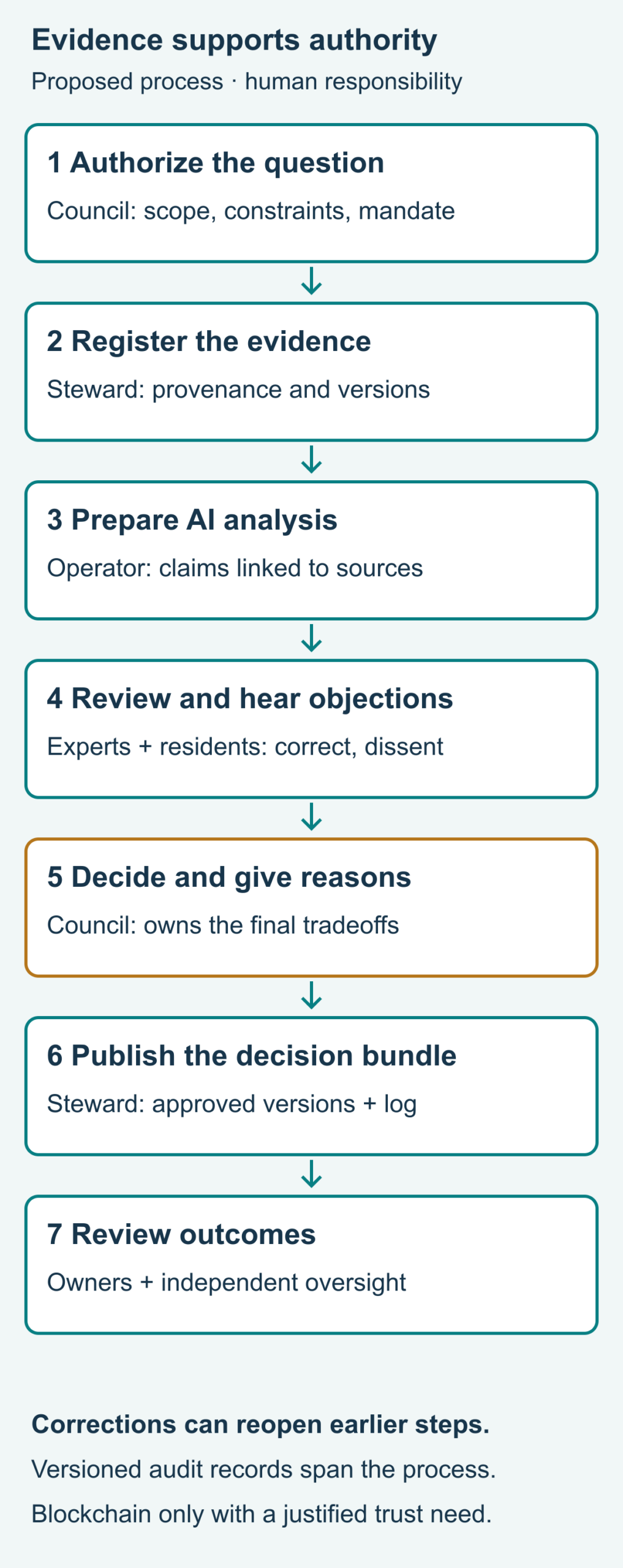
- Authorize the question. The council publishes the scope, budget constraints, participation mandate, decision authority and oversight arrangements. It approves the initial criteria after a public opportunity to challenge them.
- Register sources. A named municipal evidence steward records provenance, dates, versions, limitations and selection reasons. Specialists and residents can propose additions or contest exclusions. Publish a source-selection policy and an exclusions register, with protected detail where necessary.
- Prepare analysis. A contracted or public technical operator runs approved models against a controlled evidence snapshot. Record the model release identifier, prompts, retrieval settings, source versions and actual outputs. Preserve reproducibility limits when a hosted provider cannot supply fixed weights or deterministic execution.
- Review the claims. Named subject specialists check evidence and calculations; an editorial reviewer checks balanced representation and accessibility. Publish review status and disagreements. Reviewers disclose relevant interests and have time and authority to reject output.
- Hear and answer objections. A participation team maintains accessible channels, coverage reporting and the dissent register. An independent reviewer handles complaints about moderation, exclusion or unresolved errors, with escalation to the responsible institution.
- Decide and explain. The authorized council approves the decision and reasons. A release steward publishes a versioned decision bundle after approval; the model operator cannot silently change criteria or replace the official record.
- Check outcomes and correct course. Named implementation owners report against the baseline; an independent audit function examines process and results. Publish the response to findings, including when a decision must be reconsidered.
Across these stages, maintain a technical audit log of approved releases and changes. Keep personal data access separate from public evidence access. Use blockchain only after the interinstitutional trust case survives comparison with signed logs. Technical failure must have a fallback: pause automated analysis and continue through the established human process.
Model upgrades, prompt changes and summary-policy changes need change requests, regression checks and approval by the designated public system owner, with independent review for consequential changes. Publish what changed and why. Procurement should secure access to evidence, usable exports, audit rights and an exit path; the vendor should not control the only readable copy of the public record. Exact contract terms and disclosure restrictions require local assessment.
This avoids replacing visible elected power with an invisible platform agenda. It also applies in businesses and administrations: name the person who chooses evidence, the person who checks it and the person who owns the decision. For the software control boundary, our guide to rules, fixed AI workflows and bounded agents explains why adding language interpretation need not hand a model authority over subsequent actions.
10. Run a bounded pilot that can fail honestly
Start with preparation of one non-binding municipal investment briefing. Exclude autonomous expenditure, individual eligibility decisions and binding elections. In this proposed twelve-week pilot, use the same source snapshot to compare a conventional human-prepared brief with an AI-assisted brief. Give both teams comparable tasks, record their experience and resources, and measure all review and correction work. Randomize review order where feasible and use independent assessors who do not know which method produced a brief.
Use multiple briefing tasks or passages rather than claiming one comparison proves general superiority. Include deliberately difficult, consented test material: a stale table, contradictory claims, a small minority position and an instruction attack. These are synthetic evaluation fixtures, not fabricated public evidence. Keep live participation separate from the controlled experiment.
| Measure | What to record in the proposed pilot |
|---|---|
| Factual accuracy and source completeness | Verified claims, unsupported claims by severity, omitted decision-relevant sources and reviewer disagreement |
| Faithful representation | Coverage of independently coded positions, especially small groups; contributor correction requests and resolutions |
| Understanding and accessibility | Comprehension tasks, ability to locate evidence, assisted/offline completion, barriers by participant group |
| Participation coverage | Invitation, response and completion patterns against the affected population; report missing groups and nonresponse |
| Traceability | Whether reviewers can reconstruct what changed, who approved it and which evidence informed each release |
| Effort and cost | Staff hours, procurement, hosting, security, translation, review, complaints, training and exit costs |
| Effective challenge | Time to acknowledgement and resolution; erroneous rejections; whether accepted corrections reach the final brief |
Pre-register acceptance and stop rules. Illustrative targets might include no unresolved critical factual errors at release, evidence links for every consequential factual claim, and documented responses to all substantive objections. These are proposed pilot standards, not research-derived thresholds. A privacy incident, repeated exclusion of a minority position or inability to reconstruct an official revision should pause the affected component.
Assess the audit mechanism separately from AI quality. Test whether a signed log and independent mirror expose a simulated history alteration. Trial a blockchain only if multiple independent institutions need joint validation; compare equivalent threat scenarios, recovery effort and lifecycle cost. A successful tamper-detection test still says nothing about whether the underlying policy is good.
Satisfaction, consensus and trust are useful observations, but none alone proves factual improvement or democratic legitimacy. Report failures, uncertainty and the conventional alternative's results. Later policy outcomes need a longer follow-up and a credible evaluation design; a twelve-week briefing pilot cannot establish them.
11. The decision remains ours
Our fictional town might choose school and bus improvements, prioritize flood protection, or commission a revised package. The technology's contribution should be visible in the quality of the evidence, the treatment of objections and the ability to reconstruct and challenge the procedure.
The strongest supported claim is narrower than “AI and blockchain fix democracy.” AI has demonstrated useful performance on specific deliberative tasks; cryptographic records can support verification under stated assumptions. Their combination still needs evaluation, accountable operation and a reason to exist beyond the availability of the components.
Start with a public question, usable evidence, explicit tradeoffs and someone answerable for the result. Add technology where it demonstrably helps people do those things.