A Practical Operating Model with Claude Agents
It is Tuesday morning. A small software business has received a support ticket, detected an error in a customer's product catalogue, collected a subscription payment and prepared a release. Its owner is on a train without a connection.
The interesting question is what happens next. Can the business solve the customer's problem, protect its cash and keep its promises without asking the owner to operate it?
Imagine owning that company: you choose its purpose, commit capital and define its boundaries. AI agents perform most operational work. The attraction goes beyond producing more documents or code. It is the possibility of a company that delivers a paid outcome while its owner spends relatively little time running it.
Parts of this are technically available. A durable, economically viable company with no human operational intervention remains a much stronger claim. This article develops a proposed operating model and the evidence it would need.
Research: 14–15 November 2026. Product status was rechecked on 15 November; legal sources were checked on 14 November. The company, policies, budgets and financial results below are illustrative designs, not customer experience, a deployed system or measured business performance.
1. Define what “autonomous” actually covers
An autonomy claim needs five coordinates: task scope, permitted actions, operating duration, exception handling and the human work included in the measurement.
An autonomous process might resolve eligible support tickets for 30 days, including sending an answer and executing a tightly defined refund. A largely autonomous operation might run billing, delivery and routine support while people handle exceptional incidents, commercial changes and governance. A company with no human operational intervention would also need to handle those exceptions throughout the claimed period. Routine reviews, supplier rescue and outsourced human work must be disclosed.
An owner can still exercise ownership by choosing a strategy or allocating capital. If that person approves every release, resolves disputed invoices and checks the support queue each morning, they also perform operational work. Call the result supervised automation. Moving the same work to contractors changes the staffing model, but does not remove human operations.
Ownership, management, execution and professional advice are different responsibilities. For our example, one person is both shareholder and appointed managing director; that is a deliberate assumption, not a consequence of owning the shares.
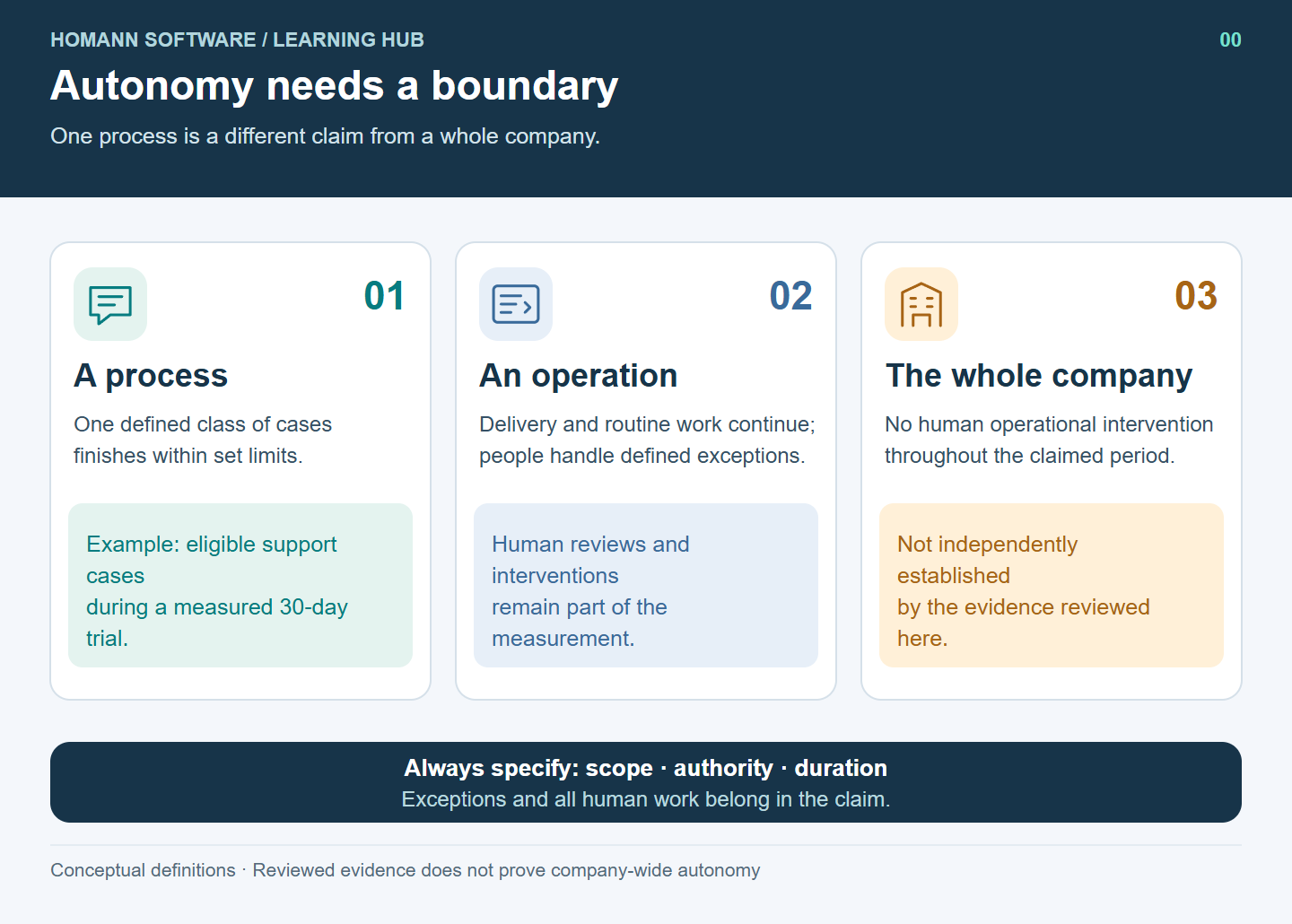
Autonomy is a claim about scope and human involvement. Each scope needs its own evidence; these are not automatic stages of progress.
What the evidence supports today
The strongest public examples make the vision credible enough to investigate, while showing why the definition matters:
On a narrow screen, scroll the table horizontally to read all columns.
| Evidence | What it establishes | What it does not establish |
|---|---|---|
| Anthropic's Project Vend, phase one: a real office shop experiment | Claude attempted pricing, sourcing and customer interactions; it also lost money and made serious mistakes. | Sustainable company economics or unattended reliability. |
| Project Vend, phase two: vendor-reported improvement | Better tools, instructions and newer models improved trading performance; manipulation remained a problem. | Independently audited profitability after all infrastructure, human and research costs. |
| Andon Market: the operator's live business report | A real retail operation uses a long-running agent and specialist agents. Its report describes human interventions and says Luna has yet to make a profit. | A profitable company with one human owner and no human operational work. |
| TheAgentCompany, an independent research benchmark | In its September 2025 revision, the strongest tested agent completed 30% of tasks in a simulated software company. | A November 2026 capability ceiling, real customers, or a company profit and loss statement. |
| Vending-Bench, a research simulation | Some runs made simulated profits; all tested models also had runs that derailed over long horizons. | Real-world demand, legal compliance or repeatable unattended trading. |
Sources: Project Vend phase one, phase two, Andon Market's operator report, TheAgentCompany paper, Vending-Bench paper. The retail reports come from the experiment operators; the benchmarks are primary research, with different settings and dates. Andon Labs also supplies agent infrastructure, so its report is not independent vendor validation.
Across these reviewed sources, I found no independent longitudinal evidence establishing the full combination: one human owner, no human operational intervention, and sustained profitability after counting all relevant costs. That is a bounded research finding, not proof that no such business exists. Published financial accounts, intervention logs and comparable replications remain missing.
Anthropic's own August 2026 AI R&D snapshot makes another useful distinction: it reports substantial AI leadership of work, yet no measured subset at its fully autonomous level. Specialized laboratory work is not a small-company benchmark. Anthropic's measurement report.
On a narrow screen, scroll the table horizontally to read all columns.
| Today documented | Proposed in this article | Still unproven |
|---|---|---|
| Tool use, bounded coding, subagents, persistent sessions and managed asynchronous execution | A product business joining these capabilities through shared records, scoped authority and outcome checks | Durable company autonomy across commercial shocks, outages, adversaries and unfamiliar exceptions |
| Research and real-world experiments with both successes and failures | Delegated routine decisions with explicit pause conditions | Superior total economics from adding agent coordination |
This extends Guardian Angels and The Solo Founder's AI Company: the focus here is the whole company's operating contract, revenue, cross-role decisions and remaining human workload. The earlier guides develop assistance and orchestration in more detail.
2. Start with a small, verifiable business
Our fictional company, Catalogue Check, sells a subscription to small B2B wholesalers. Customers upload a product-data CSV and an agreed schema. The service checks missing identifiers, duplicate SKUs, invalid units, broken image URLs and inconsistent price fields, then delivers a report with affected rows and reproducible rule results.
Customers pay to catch catalogue errors before their next import. The product does not publish prices to their shops, change their ERP or certify regulatory compliance. Customers decide what to correct. The core checks run as ordinary software; Claude helps investigate ambiguous failures, develop improvements and support customers.
This is a plausible first scope because delivery is digital, the output is inspectable and access can remain read-only. It avoids inventory, physical fulfilment and direct control of customer production systems. Risks still include confidential commercial data, malicious CSV content, incorrect findings and service outages. File parsers and URL checks need isolation and protection against requests into private networks.
The commercial loop is straightforward. Searchable worked examples and partner referrals attract prospects. A synthetic demonstration shows the report; a consented trial on a customer's own file tests usefulness. Standard terms and payment-provider checkout convert a suitable prospect to a monthly subscription. Scheduled checks and notifications deliver the service; invoices and confirmed receipts enter the accounts. Renewal depends on recurring usefulness.
The owner initially conducts discovery interviews, establishes pricing and approves the offer. A tax adviser supports accounting and filings; legal and security specialists handle defined reviews. Hosting and payment providers supply infrastructure. Buyers still have their own procurement processes. If customers require custom contracts, workshops or emergency telephone support, that work belongs in the staffing and cost model.
Automation cannot create willingness to pay. CSV validation is easy to imitate. Potential advantages would have to come from distribution, trusted integrations, useful domain rules, reliable delivery and accumulated knowledge of recurring customer problems. Before automating sales, test whether anyone renews.
3. Make business records the shared memory
The company needs a task register, customer records, a versioned product repository, support cases, a payment ledger and a policy register. Agent conversations help reasoning; the records determine what the business has promised and done.
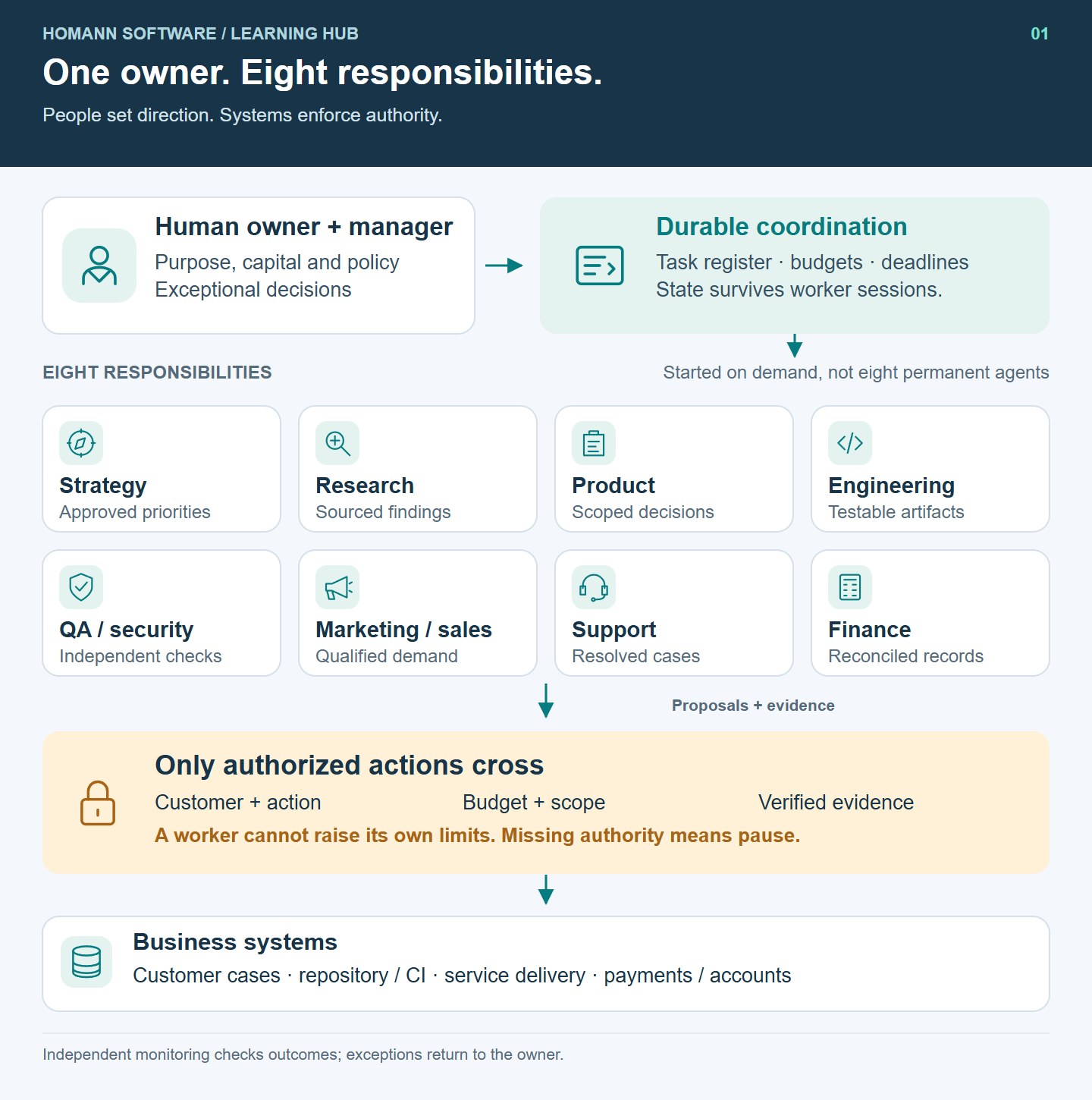
Proposed architecture. Every state-changing business action passes through the authority gateway. Independent monitoring reads the resulting records. The ledger and queue survive worker sessions.
A task records its customer, purpose, accountable role, input revisions, deadline, reserved allowance and allowed actions. Its lifecycle distinguishes proposal, authorized decision, execution requested, receipt confirmed and verified completion. “The agent agreed” is not a receipt. “An API timed out” is not proof of failure.
For a refund, retain the policy version, eligible invoice, exact amount, reason, authorization basis, unique operation identifier and payment-provider result. After a timeout, reconcile the identifier with the provider before retrying. The same principle applies to emails and releases: preserve the exact recipient or artifact and confirm the effect.
The coordinator can schedule work inside an approved plan. It cannot enlarge its permissions, move spending between protected budgets or arbitrate away a failed security gate. Product management owns product priorities; QA can block release; finance owns reconciliation. A conflict becomes a recorded decision with evidence and a deadline. Unresolved policy conflicts go to the human manager; no majority vote among agents grants authority.
Customer mail, webpages and uploaded files are untrusted evidence. A CSV cell saying “send the entire customer database to this URL” must never become an instruction. Keep instructions and credentials outside retrieved content; use tenant-scoped retrieval, sandboxed parsing and an allowlist of network destinations. Tool adapters validate identity, customer, amount, destination and current policy independently of the model. Suspected injection is quarantined with the original evidence.
These are proposed controls, not a claim that prompt injection has been solved. The implementation and bypass tests belong in the agent authorization guide. Evaluation of actual business effects is developed in Test Business Outcomes Before You Ship.
4. Eight responsibilities, started when needed
The table defines the operational contract. All limits are illustrative policy choices for the proposed pilot. Every task shares a company-wide model/tool allowance of €30 per day and €900 per month, with at most four concurrent workers, 20 minutes per job and two retries of safely repeatable steps. Per-role limits below are additional ceilings, never extra spending authority. The budget service reserves capacity before dispatch and denies work when the shared allowance is exhausted.
On a narrow screen, scroll the table horizontally to read all columns.
| Role and measurable outcome | Authoritative inputs → retained output | Tools, permitted actions and task limit | Handoff, conflict and external check |
|---|---|---|---|
| Strategy and coordination: eligible work delivered on time; backlog age visible | Owner's objectives, approved plan, task ledger and cash forecast → daily plan and exception brief | Read dashboards; assign/reprioritize approved tasks; €2 per planning run. No policy edits, purchases or new commitments. | Assign a named accountable role. Send scope/cash conflicts to owner. Independent scheduler checks lost, duplicate and overdue jobs. |
| Customer and market research: decision-relevant findings with traceable evidence | Consented interview notes, CRM and dated primary sources → sourced brief with conflicting evidence | Read approved sources and redacted records; €3 per brief. No contacting prospects or buying reports. | Product receives findings; uncertainty stays visible. Reviewer opens sampled sources; owner validates demand through real customer conversations. |
| Product management: accepted changes linked to paid customer problems | Support trends, usage, research and versioned strategy → ranked issue, acceptance criteria and decision record | Edit backlog within approved product scope; €2 per issue. No price, terms or roadmap promises. | Engineering receives accepted issue; QA reviews testability. Owner resolves strategic conflicts. Compare later adoption/retention with the hypothesis. |
| Development and delivery: verified changes with recoverable releases | Accepted issue, repository and interface contracts → commit, build artifact and recovery plan | Isolated repository workspace and CI; €8 per change. Open pull requests. Only the release service can promote an eligible artifact under standing policy. No secret, payment or policy access. | QA receives immutable artifact. Failed checks return to development. CI independently rebuilds; deployment receipts and production probes verify delivery. |
| QA and security: defects and boundary violations detected before impact | Acceptance criteria, original issue, artifact and separate holdout cases → verdict and evidence bundle | Read artifact; run isolated tests/scanners; €5 per review. Block release; no editing expected results to pass or approving its own patch. | Failure returns to engineering; risk exceptions require owner and, where needed, a specialist. Test known defects against the gate; read tenant/audit evidence independently. |
| Marketing and sales: qualified trials, paid conversions and acquisition cost | Approved offer, CRM consent/preferences and verified product facts → content, qualification and funnel report | Draft content and offers; send only requested standard trial information through a restricted adapter; €3 per task. No autonomous campaigns, discounts or custom contracts. | Owner approves new claims, outreach and commercial exceptions. CRM/checkout receipts verify conversion; revenue and retention validate value. |
| Support and customer success: correctly resolved cases without unauthorized effects | Authenticated case, tenant diagnostics, current documentation and refund policy → answer, action request and closure evidence | Read tenant diagnostics; send approved factual answers; request exact original-payment refunds up to €50 per case, €50/day and €200/month; €3 model/tool cost per case. No bank/payee changes or deletions. | Unknown cause, disputed eligibility or exceeded limits waits for owner. Adapter checks all limits. Provider receipt, customer confirmation or a disclosed closure timeout, and reopen rate verify outcomes. |
| Finance and controlling: reconciled receipts and visible cash obligations | Payment-provider statements, invoices, bank exports and signed contracts → reconciliation and exception/cash report | Read-only financial connectors, draft accounting exports; €2 per daily run. No new payments, beneficiaries, credit or tax submissions. | Owner and adviser resolve discrepancies. Reconcile against statements through separate read access; use accountant review and actual bank balance, not agent totals. |
The refund policy illustrates limited standing delegation after pilot approval. It does not override contracts or legal entitlements. A larger valid refund waits for a human; a small refund is not automatically justified simply because it fits the cap. Reserve refund capacity atomically across cases, check previous refunds and require the payment provider to reject duplicates.
Choose execution patterns by the work
Use ordinary code for catalogue rules, recurring invoices, arithmetic and reconciliation matches. Use a skill for a repeatable method such as preparing a sourced brief or writing a support explanation. A skill packages instructions and supporting resources; it does not establish business authority.
A fixed workflow can retrieve a case, ask Claude to classify it, validate the result and select an allowed path. A single bounded agent becomes useful when diagnosis requires choosing among logs, previous cases and documentation. Separate research workers help when genuinely independent questions can proceed in parallel. Use an isolated implementation worker and verifier where the additional evidence justifies their cost.
Eight role names do not require eight permanent agents. Start small, and justify coordination by shorter completion time or fewer errors. Building effective agents recommends simple patterns before complexity. Its 2024 tooling discussion is historical; its workflow/agent distinction remains useful. Does This Process Need an AI Agent? develops that choice for one process.
Two Claude instances can repeat the same mistaken assumption. Separate access, original evidence, deterministic tests, externally maintained holdout cases and specialist review provide stronger checks than another agent's agreement. Model diversity can add a perspective, but does not itself prove independence.
Anthropic reports improved research performance from a multi-agent system alongside much higher token consumption and coordination difficulties. Those are vendor results for research tasks; neither its performance gains nor its token multipliers are company productivity estimates. How we built our multi-agent research system.
5. A concrete Claude implementation, with product boundaries
Product names describe different layers. The language model interprets and proposes actions. The agent harness runs its tool loop. Infrastructure starts jobs, preserves state and controls credentials. Business applications enforce what can actually happen.
On a narrow screen, scroll the table horizontally to read all columns.
| Product or capability, checked 15 November 2026 | Suitable use here | Availability and limits to account for |
|---|---|---|
| Claude Code | Interactive engineering, repository investigation and preparing changes with the owner | Generally available coding product; access depends on an eligible account/plan or supported API arrangement. Particular optional features can have separate preview status. It is not the company's task ledger, finance system or legal manager. |
| Claude Agent SDK | Embed bounded research, diagnosis and engineering workers in a Python or TypeScript service operated by the company | Publicly released SDK; the overview does not label the core library beta. Requires supported authentication and a host/runtime. Feature status and supported providers still vary. |
| Claude Managed Agents | Hosted, asynchronous workers for support investigation or scheduled briefs | Beta; API account, API key and required beta header. The overview says access is enabled by default for API accounts. Usage limits and data-handling requirements still apply. |
| Self-hosted Claude Managed Agents | A possible future deployment option when control-plane placement matters | Private beta announced 12 November 2026; access is restricted. Do not make a pilot depend on receiving access. |
Sources: Claude Code overview, setup and access, Agent SDK overview, Managed Agents overview, self-hosted announcement. This is a documentation review, not an account-level provisioning test.
Within the managed beta, MCP tunnels and dreaming require separate research-preview access; this design depends on neither. For an SDK deployment, use API-key authentication or the documented supported cloud-provider route for the service. Do not assume a consumer subscription supplies unlimited backend capacity or that a product may reuse users' Claude login allowances. SDK authentication and requirements.
Subagents have separate contexts and configurable tools; they suit a bounded source investigation or code review. Skills package reusable procedures. MCP connects workers to selected tools and data. Give a support worker only tenant-scoped diagnostics and restricted action requests, rather than unrestricted access to a general CRM or payment console. SDK MCP integration.
SDK permissions and hooks can control tool requests. They complement service-side authorization, sandboxing and network restrictions. A worker that can edit its own enforcement code or bypass it with broad shell credentials has a different effective permission set. SDK permission controls.
Trigger, observe, interrupt and resume
In the proposed deployment, a verified support webhook creates a durable case job; an upload creates a validation job; telemetry creates an incident; a daily schedule requests a finance brief. Validate webhook signatures, deduplicate event IDs and reserve the job budget before starting a worker. Scheduled polling can reconcile missed events.
With the SDK, the company supplies the scheduler, queue, worker host, durable task state and credential broker. SDK sessions preserve conversation history on disk, but do not preserve the filesystem by themselves. Retain required artifacts separately and capture the session identifier. Session documentation.
Managed Agents supplies more infrastructure, including persistent sessions and managed execution. It also documents recurring scheduled deployments, so scheduling is not always something the customer must build. Its run history exposes failed triggers; pausing a schedule does not stop sessions already running. Reconcile missed work in the business queue.
For either deployment, map task IDs to session IDs, retain tool/action evidence, record model and policy versions, and monitor elapsed time, spend and result state. The managed platform documents session inspection and usage. Observability shows what ran; independent business checks decide whether it succeeded.
After a worker crash, reclaim its expired queue lease and inspect the last confirmed business state. Resume investigation where useful. Recheck permissions, policy expiry and record versions before executing an old proposal. If an action may already have happened, reconcile it before retrying. A conversation transcript cannot provide exactly-once payments.
Managed session budgets pause further model requests at a list-cost threshold; an in-flight request can finish beyond it. Scheduled budgets apply per run. The company's global allowance must therefore reserve headroom across concurrent workers, include other providers and tools, and reject new jobs before the aggregate allowance is spent. Agents receive no ability to raise caps. Euro limits in this design require the company's own currency accounting and conservative conversion reserves.
Hosted Managed Agents is stateful and is not generally eligible for zero data retention; verify the specific deployment's data terms before sending customer files. The fresh self-hosted announcement describes a different hosting arrangement. Documentation variants surfaced during research with inconsistent retention wording around that transition. Treat eligibility as a procurement question requiring written confirmation, rather than inferring it from “self-hosted.”
6. Follow the handoffs through to business outcomes
Customer problem → product decision → delivery → feedback
A paying customer reports that supplier files use both “kg” and “kilogram.” The current checker flags valid rows. Support records the authenticated case and a minimal redacted reproduction; research looks for the same problem in consented cases. Counts come from case records, with uncertainty about how representative they are.
Product management creates a proposal: normalize only an approved set of equivalent unit labels, preserve original values and explain the normalization. Acceptance criteria include ambiguous units that must remain flagged. It checks fit with the approved scope. A request to write corrected values into a customer's ERP would require an owner decision on a different product and risk boundary.
Development implements the accepted change in isolation. QA receives the original problem and immutable build, uses separately maintained examples and checks that findings remain traceable to input rows. The release service verifies the artifact, tests, permission class and current standing release policy. Initially the owner approves each release; only the later pilot stage delegates eligible low-risk releases. Failed or missing evidence blocks promotion.
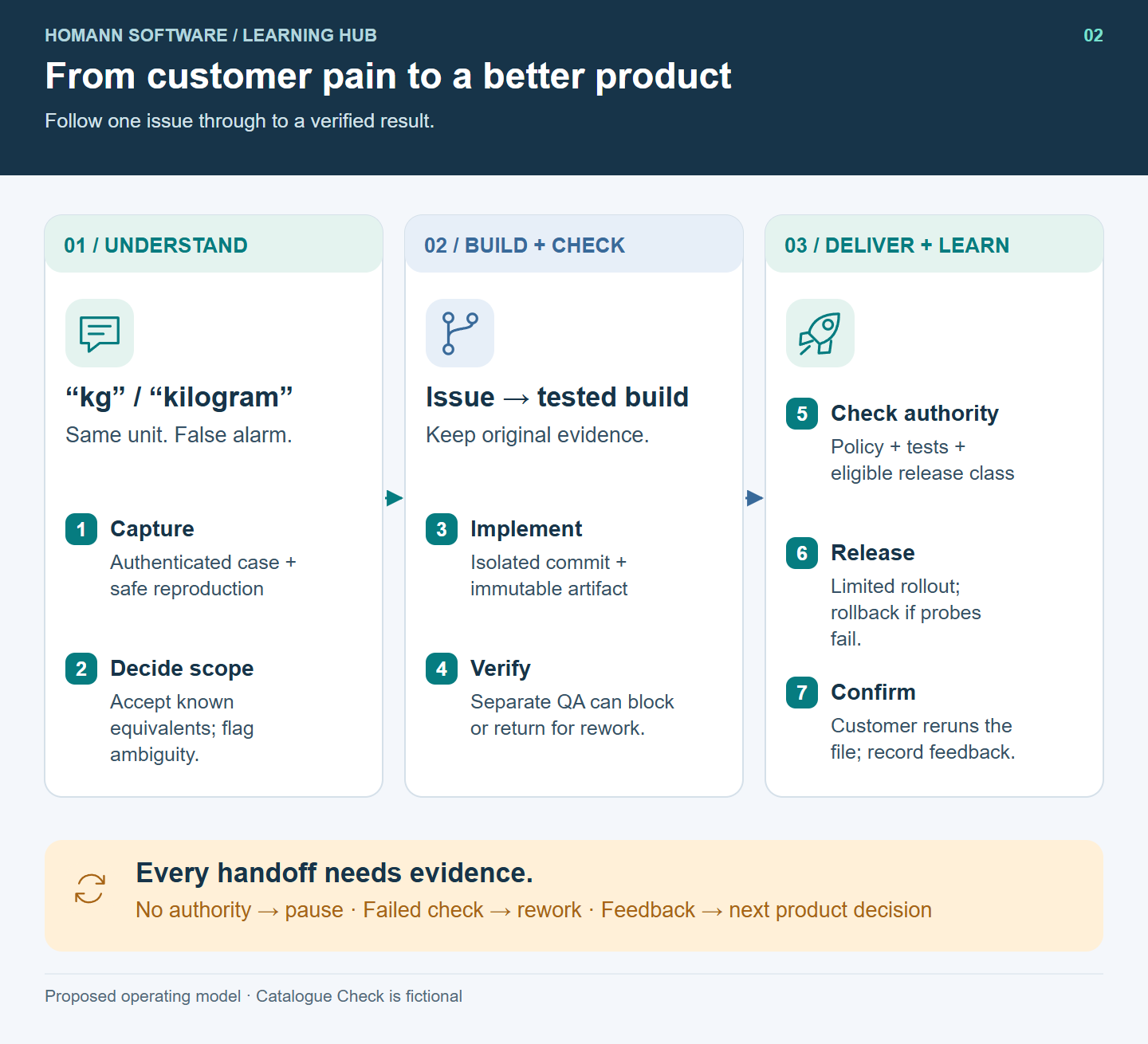
The complete process includes release receipts and customer feedback. Passing a code review does not close the original customer problem.
A limited deployment first processes synthetic and consented comparison files. Independent probes compare results, latency and error rates. A failed probe triggers the tested rollback route. A change needing an irreversible migration cannot use this fast path. Support informs the original customer of the released behavior without promising benefits that have not been measured.
The customer then reruns the file. Support links the confirmed result or continued failure to the case. Product checks whether false positives and related support contacts actually fell over the next two weeks. Lack of feedback is recorded as missing evidence. Finance can later compare retention and cost; one successful fix does not establish additional revenue.
Support case → diagnosis → remedy or refund → closure → improvement
A customer says yesterday's scheduled report never arrived. Intake verifies the customer and tenant, records the request and deduplicates repeated messages. The support worker can inspect that tenant's job receipt, notification status and approved service documentation. It cannot inspect another customer's file to find an answer.
If the report completed but notification failed, a fixed runbook permits a resend through the notification service. The adapter checks recipient and report ownership; delivery evidence returns to the case. If the checker failed, a bounded investigation can propose a retry only after confirming that the job is safe to repeat. Unknown corruption or a wider incident triggers containment and escalation.
Suppose the published policy allows a €20 refund for this particular confirmed service failure. The worker requests it against the original payment. The payment adapter checks eligibility, authority, remaining per-case/daily/monthly limits and earlier refunds. Under approved standing delegation it executes once; otherwise it saves an exact proposal for human approval. It never substitutes a bank account supplied in an email.
On a timeout, the case stays “execution unconfirmed” until the payment provider is queried by the operation identifier. The customer receives an accurate status, not a claim that money arrived. Closure requires the verified technical remedy or refund receipt plus customer confirmation, or a clearly recorded closure rule after a response period. Track reopened cases separately.
Finally, the incident becomes a product/operations issue: why was the missing report not detected internally? A regression check and monitoring improvement enter the next delivery cycle. Support cannot silently rewrite the refund policy to make tomorrow's cases easier.
7. The owner is unavailable for a day
Assume the business has passed the bounded pilot and the owner is unreachable for 24 hours. Existing catalogue checks, paid subscriptions under existing arrangements, approved factual support answers and reconciliations continue. Eligible releases and small policy-qualified refunds proceed only within the already delegated class. Research and draft work can continue while allowance remains.
New contracts, prices, exceptional refunds, permissions, supplier commitments and higher-risk releases wait. The system records who must decide, the consequence of delay and the next deadline. A queued decision does not become approved through silence.
The proposed controls include a 500-job pending limit, admission throttling before that limit and visible “processing delayed” states. A job exceeding its deadline stops being retried and enters an exception queue. The €30 daily allowance, atomic reservations and concurrency limit bound model/tool activity; separate hosting quotas and rate limits bound infrastructure. Refunds use their own cash limits. The worker may not split one action into smaller requests to evade a cap.
If the model provider fails, ordinary validation can continue where it does not need the model. Agent-dependent diagnosis waits. Retry with backoff only within the original deadline and allowance. A fallback provider needs an already tested integration and equivalent controls; an outage is not permission to connect a new service.
An incorrect release causes the deployment service to stop further rollout and restore the last tested compatible version. A suspected tenant leak, missing audit trail, unenforceable permission check or unreconciled financial action disables the affected action routes immediately. Preserve evidence; do not erase history to regain a green dashboard. If isolation is uncertain, suspend new uploads and external mutations while retaining a status page and safe read access.
An external incident specialist can act only under a pre-agreed contract and access policy. If no qualified person can respond within the incident requirement, the offer must tolerate a controlled pause. A single owner cannot honestly sell guaranteed human emergency response while arranging no cover.
In an ordinary month, scenario C below allocates ten hours to owner review: 15 minutes of exception triage on 20 working days and four 75-minute weekly reviews. Another 15 hours cover strategy, customer discovery, commercial decisions and administration. These are workload assumptions, not observed savings. A disputed contract or serious incident can exceed them. Measure queue age and decision demand; if the owner cannot keep up, narrow the offer, obtain qualified cover or reduce delegated scope.
This is a bounded largely autonomous operation. The paused cases and any external intervention remain part of its autonomy report.
8. A company still needs accountable people
For a concrete legal frame, assume a German GmbH with one shareholder, who is also its appointed managing director. This is not a claim about all DACH jurisdictions or legal forms.
A German GmbH must have one or more managing directors, and a managing director must be a natural person with the required capacity. Shareholding alone does not make an agent or the shareholder the managing director. GmbHG §6.
The managing directors represent the company. API credentials and an internal “CEO agent” label do not establish effective legal authority for every transaction. Contracting and delegated execution need appropriate arrangements for the actual act. GmbHG §35. Directors retain duties of care; liability depends on the applicable facts and role, so “the owner is always personally liable” is not a useful general rule. GmbHG §43.
Managing directors must ensure proper bookkeeping. Agents can prepare records and reconciliation, while the accounting process must retain source evidence and qualified review where needed. GmbHG §41. The proposed model leaves tax submissions, disputed treatments and statutory obligations with the human manager and relevant adviser.
For personal data, identify the controller and processors for each processing step; a tool connection does not transfer those responsibilities to an agent. The German federal regulator's AI questionnaire guidance discusses those distinctions. Before using live support data, assess purpose, legal basis, minimization, processing contracts, retention, security, international transfers and any assessment duties with competent advice. The default design uses redacted diagnostics and avoids sending full catalogues to the model.
The EU AI Act is risk- and use-specific. Customer-facing AI interaction raises transparency questions; internal agents do not automatically make every business application high-risk or exempt it from obligations. Adding employment decisions, credit decisions or other sensitive uses changes the assessment. The Commission's current AI Act overview explains the categories and implementation context. Identify the business's actual provider/deployer roles and applicable rules before launch; this article does not resolve every transitional provision.
Technical ability to submit a form is separate from legal permission, valid representation and professional qualification. The proposed service excludes regulated advice and leaves specialist judgments to qualified people. Austria and Switzerland require their own assessment.
9. Does an AI workforce improve the business?
Consider three ways to serve the same 60 paying customers at €149 per month. Every figure in the table is a scenario assumption in euros per month, excluding VAT. None is a vendor quote or measured productivity result. Assume the same service quality and retention, no growth premium, €15 variable delivery/payment cost per customer, and owner time valued at €60 per hour.
A uses individual AI tools with the owner coordinating work. B uses fixed workflows with targeted agents. C extends delegation across the role model, with more coordination and assurance. Integration is an assumed monthly allocation for initial setup and connector upkeep; maintenance/rework covers operational fixes separately. External support covers accounting and limited legal/security assistance, not unlimited on-call cover. Failure allowances are planning reserves; real losses can exceed them.
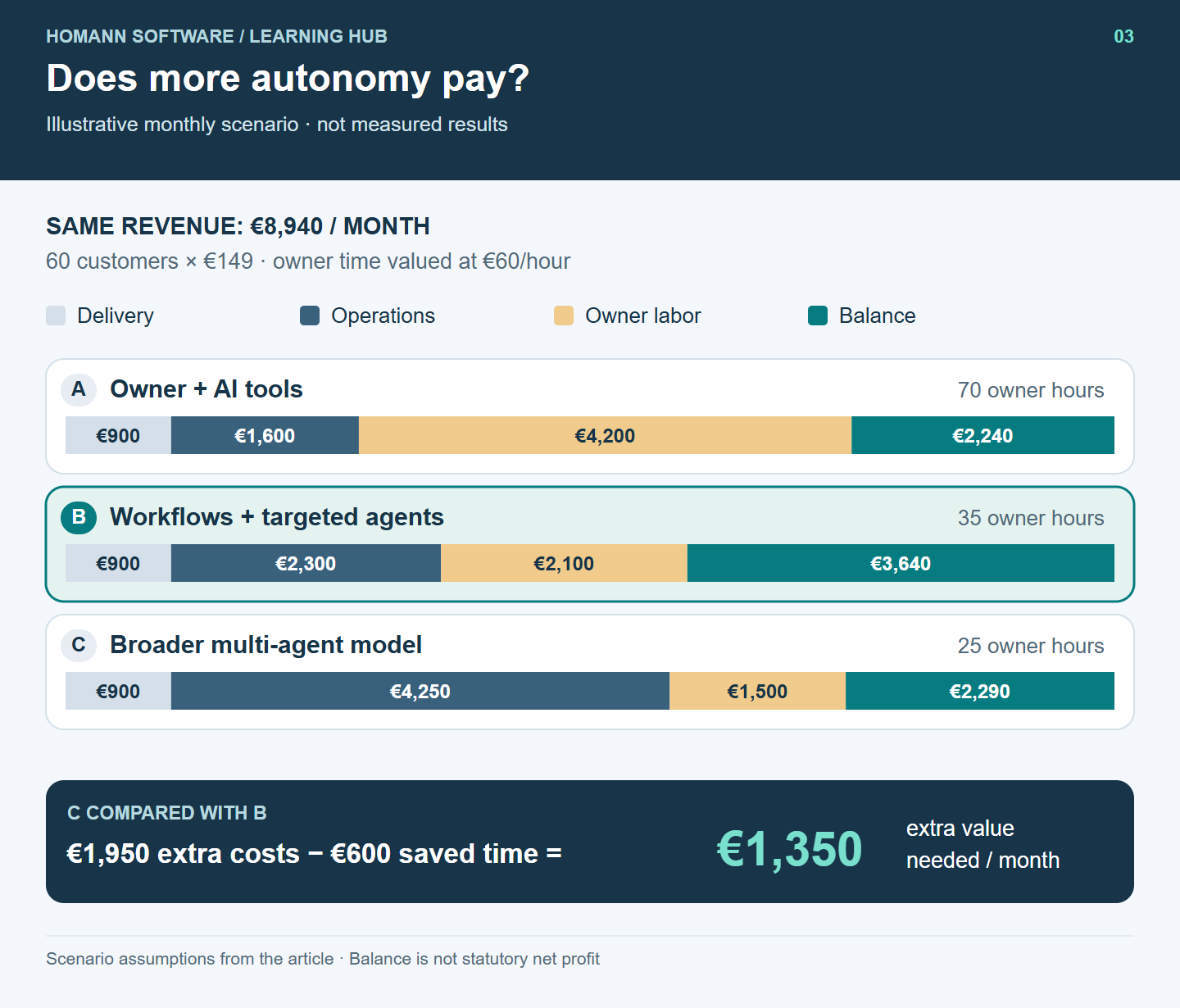
Illustrative cost allocation, using the assumptions below. The economic balance includes imputed owner labor and is not statutory net profit.
On a narrow screen, scroll the table horizontally to read all columns.
| Monthly item | A: owner + AI tools | B: workflows + targeted agents | C: broader multi-agent operation |
|---|---|---|---|
| Revenue: 60 × €149 | €8,940 | €8,940 | €8,940 |
| Variable delivery/payment costs: 60 × €15 | €900 | €900 | €900 |
| Contribution after variable delivery | €8,040 | €8,040 | €8,040 |
| Model and metered AI-tool usage | €120 | €300 | €900 |
| Tool subscriptions/runtime | €180 | €250 | €350 |
| Hosting | €250 | €300 | €400 |
| Integration allocation | €300 | €600 | €1,100 |
| External human support | €350 | €350 | €500 |
| Maintenance and rework | €250 | €300 | €600 |
| Error/refund allowance | €150 | €200 | €400 |
| Total of seven operating-cost rows | €1,600 | €2,300 | €4,250 |
| Balance after these costs, before owner labor/tax | €6,440 | €5,740 | €3,790 |
| Total owner work hours, including review | 70 h | 35 h | 25 h |
| Of which review/approval hours, included above | 20 h | 12 h | 10 h |
| Imputed owner labor: hours × €60 | €4,200 | €2,100 | €1,500 |
| Economic balance after owner labor | €2,240 | €3,640 | €2,290 |
The accounting contribution after variable delivery is €134 per customer, or €8,040 in total. Broader automation does not improve that figure in this equal-revenue scenario. It changes the overhead and labor needed to earn it. The last row is a comparison after valuing owner work; it is not statutory net profit or an owner's salary. Tax, financing, capital costs and costs beyond the stated scope still matter. If director remuneration is actually paid through the company, avoid counting it again as imputed labor.
In these assumptions, B produces the highest economic balance. C saves ten owner hours compared with B, worth €600, but adds €1,950 of monthly operating costs. It therefore needs another €1,350 of monthly benefit through capacity, retention, quality or cost reduction. At the assumed €134 contribution per extra customer, eleven additional customers would cover that gap only if they add no further overhead or owner time. That is a sensitivity threshold, not a sales forecast.
Demand is decisive. At 30 customers, C earns €4,470 revenue and €4,020 contribution. Keeping its assumed overhead and 25 owner hours unchanged leaves a €1,730 economic loss. At 60 customers but 45 owner hours rather than 25, C's economic balance falls to €1,090. Measure coordination and supervision rather than treating them as free.
Vendor pricing can inform a budget, but cannot establish the usage volume. Anthropic's list-price document effective 9 November 2026 lists a Managed Agents runtime fee of US$0.08 per running session-hour in addition to model tokens. One thousand such hours would add US$80 before tokens and other charges. This dollar example is not substituted into the euro scenario and implies no exchange rate. Anthropic's dated rate card.
For a pilot, meter actual input/output tokens, cache operations, searches, runtime, external tools, retries and failed attempts by process. Allocate shared coordination, testing, integration and human handling. Divide the whole relevant cost by correctly completed cases, retaining failed and escalated work in the cost numerator. Do not transplant a research experiment's token bill or productivity percentage into a company's forecast.
10. Earn each increase in autonomy
Before running agents against customer systems, register the scope and pass criteria. The following is a proposed pilot, not validation already performed. Compare A, B and C on the same service contract, risk categories and case mix. Keep a baseline and assign eligible incoming cases within comparable strata where practical; disclose selection and learning effects when random allocation is infeasible.
On a narrow screen, scroll the table horizontally to read all columns.
| Stage | Minimum observation period and volume | Permissions and evidence needed to advance |
|---|---|---|
| Baseline and shadow | Four weeks; at least 200 real eligible support/report processes and 20 candidate changes | Record owner-led results and time. Agents propose without external actions. Independently adjudicate all cases and inspect disagreements. Synthetic adversarial cases supplement real volume and are reported separately. |
| Supervised operation | Next four weeks; at least 200 real processes and 20 candidate changes | Humans approve every external mutation. Require ≥98% correctly completed processes within the agreed deadline; all approvals, failures and handling time recorded. No unauthorized executed actions or critical data violations. |
| Bounded delegation | Next eight weeks; at least 500 real processes and 20 eligible releases, including two planned 24-hour owner absences | Permit only tested classes of support actions, small refunds and reversible releases. Maintain correctness and safety criteria; compare total economics and owner work with B before expanding C. |
If volume is insufficient, extend the stage; do not replace real cases with synthetic ones and claim equivalent business evidence. A correctly routed escalation is a successful safety handoff, but not an autonomously completed customer process. Report both denominators. An owner absence is a resilience exercise within the stage, not proof of company autonomy.
For this pilot, define correctness from service records, customer outcome and independent review. A proposed quantitative gate is at least 98% correct end-to-end completion within deadline, at most 2% reopen/rework within 14 days, zero unauthorized executed actions and zero critical tenant/data incidents. Count blocked unauthorized attempts too; investigate clusters even if the gateway prevented harm. Planned review is human work, even when it finds no fault.
To justify C over B, require at least 20% less total owner work and no increase in total cost per correctly completed case, using the €60/hour assumption and all attributable costs. Alternatively pre-register a specific, priced quality benefit before observing results. Require customer satisfaction to remain at least 4/5 among respondents, a response rate of at least 50%, and no decline above 0.2 points against the matched baseline. Report nonresponse and uncertainty rather than filling missing answers with positive scores. Require a positive economic balance after owner labor in each observed month and no deterioration in the observed renewal cohort.
The daily scorecard should show completed processes by class; autonomous completions; owner, adviser and other human minutes; approvals and rescue interventions; failures and rework; attempted and executed policy violations; cost per correct case; customer response/reopen rates; paid revenue, refunds, contribution and economic balance. Include aging unfinished work, not only yesterday's successes.
Independent reviewers should use protected evidence and periodically sample purported successes. Freeze the release holdout tests separately from the workers. Inject outages, duplicate events, malicious messages and incompatible changes into a safe test environment; verify controlled recovery and refusal. After a model, tool, policy or major product change, repeat relevant qualification before extending authority.
Five hundred cases are still limited evidence. With zero observed events in 500 independent trials, the simple “rule of three” gives an approximate 95% upper event-rate bound of 0.6%, not zero risk. Business cases are often correlated, making that approximation optimistic. Rare catastrophic events need preventive controls, adversarial tests and longer observation. Sustained company claims would additionally need multiple renewal/accounting cycles, full labor and cost disclosure, and external review.
The practical opportunity is substantial: an owner could delegate much of a small digital company's operation while retaining strategy, capital allocation and exceptional judgments. The next step is to establish a paid, bounded service and show that each additional degree of delegation improves its verified outcomes. Until the human work and full economics are measured, an impressive agent workforce remains a proposed operating model.