You can build a convincing AI prototype in a weekend. On Monday, the harder questions begin: Who urgently needs it? Who controls the budget? How will those people find you? What evidence would make them buy?
For many technical founders, building feels familiar. Selling feels uncertain. AI can make that imbalance more expensive: it becomes easier to create features before discovering whether anyone wants the underlying outcome.
The commercial opportunity is to turn engineering capability into a repeatable path from customer problem to paid, retained use. This guide explains the commercial work step by step, with two fictional examples: a business SaaS product and a consumer mobile app. You will learn how to choose an audience, explain your value, attract suitable buyers and measure whether your marketing leads to lasting use. An optional tested economics lab is available as a download.
Researched on 10 November 2026. Survey findings below describe their respective samples. All product names, prices, funnels and customer results in the worked example are fictional teaching assumptions.
1. What has changed in 2026?
Three developments matter more to a small software business than another list of AI tools.
First, increased coding output does not automatically increase business throughput. Atlassian’s report commentary, published on 20 October 2026, says 87% of surveyed developers report faster shipping with AI, while 72% experience unchanged or greater friction. These are self-reports, not a controlled estimate of productivity. They support examining the whole delivery system rather than assuming that faster coding solves every constraint. Atlassian, 2026
Second, buyers increasingly research software through AI before meeting vendors. Semrush’s July 2026 study reports that 66% of its AI-using respondents regularly use AI to research vendors and solutions. The denominator matters: the findings cover 519 US professionals who said they use AI for work, drawn from 622 valid responses. This is not evidence that two thirds of all buyers everywhere behave identically. Semrush, July 2026
Third, convincing one enthusiastic user may be insufficient. Forrester’s January 2026 release describes buying decisions involving multiple internal stakeholders and external influencers, with trials helping buyers reduce perceived risk. Its broad B2B findings should not be used to predict the exact buying group for a small developer tool. The practical implication is to prepare evidence for users, budget owners and technical reviewers. Forrester, January 2026
The 2026 6sense buyer report adds a useful warning: confidence in understanding vendors’ AI implementation fell from 82.5% in its 2025 findings to 72.7% in 2026. Explain what your AI does, what it cannot do, where data goes and who reviews its output. 6sense, 2026
My editorial conclusion is that the most useful topic for a technically oriented AI business is evidence-led customer acquisition: making a specific outcome discoverable, credible and easy to evaluate. This is a synthesis of the sources, not a measured universal ranking of IT trends.
2. Find the actual bottleneck
The premise “AI makes production easier, so sales becomes the bottleneck” is a useful hypothesis. Test it against your business.
If qualified buyers are waiting but integrations take months, delivery may still be the constraint. If many people try the product but nobody gets value, activation may be the constraint. If customers leave after one month, retention deserves attention before buying more traffic. If you can deliver and retain value but have few qualified conversations, acquisition is a reasonable place to invest.
Illustrative capacity model, not market data. A fictional team can build for eight new customers per month but attracts only two purchase-ready customers. Doubling build capacity alone leaves completed customer starts at two, assuming all other constraints remain unchanged.
Use a weekly diagnostic:
| Observed symptom | Investigate first | Useful next experiment |
|---|---|---|
| Few relevant visitors or introductions | Reach and positioning | Interview buyers; test one narrowly targeted message |
| Relevant visitors, few enquiries | Offer and trust | Add a specific use case, demo and explicit next step |
| Many demos, few paid pilots | Qualification and buying risk | Confirm urgency, authority, data access and success criteria |
| Many trials, little meaningful use | Activation | Observe five users attempting their first valuable task |
| Customers join and quickly leave | Outcome, reliability and fit | Interview departures; inspect usage and support failures |
An engineer already knows this pattern: measure the system, identify the constraint, change one thing and inspect the result. Commercial work benefits from the same discipline.
3. Marketing, sales and product marketing in plain English
Marketing helps the right people discover and understand a relevant problem and your approach to solving it. Sales helps a particular buyer decide whether to commit. Product marketing connects the product to the market: who it is for, how it differs, how to explain its value and what proof supports that explanation.
A go-to-market strategy, often abbreviated GTM, joins these decisions: target customer, offer, route to market, pricing, onboarding and retention. A customer relationship management system, or CRM, records the people, companies, opportunities and agreed next steps. Start with a small spreadsheet if it keeps those facts clear.
Software as a service, or SaaS, means customers access software as an ongoing service, commonly through a browser and a subscription. A mobile app runs on a phone or tablet and often reaches users through an app store. These categories overlap: a mobile app can be part of a SaaS service. Here we compare a business SaaS subscription with a consumer app subscription because their buying journeys differ.
Business-to-business (B2B) means selling to an organization. Business-to-consumer (B2C) means selling to an individual. For the B2B example, QuotePilot helps maintenance companies draft quotations. For the B2C example, PocketWords helps adults practice vocabulary in short mobile sessions. Both names describe fictional teaching products; their features and results are illustrative.
| Question | QuotePilot: business SaaS | PocketWords: consumer mobile app |
|---|---|---|
| Who uses and pays? | Staff use it; a manager may approve the subscription | Usually the same person chooses, uses and pays |
| What needs explaining? | Workflow fit, evidence, implementation and business value | Immediate usefulness, experience, price and reasons to return |
| Where can evaluation happen? | Website demo, sandbox, conversation and pilot | Store listing, first session and optional trial |
| What is a meaningful first success? | A reviewed quotation draft from a suitable request | Completing a useful vocabulary practice session |
| What confirms commercial progress? | Paid pilot, rollout and renewal | Activated use, paid conversion and subscriber retention |
Being introverted is compatible with selling software. You need careful questions, honest explanations and reliable follow-through. Your technical strengths can help you show a workflow, investigate a failure and explain a trade-off precisely.
4. Turn a feature into a focused offer
Consider a fictional product called QuotePilot. It helps industrial maintenance service teams prepare draft quotations from incoming service requests. A person checks scope, price and terms before sending anything.
The technical description might be “an LLM application with document retrieval and workflow integrations.” A buyer still needs to know why it matters.
A clearer offer is:
For industrial maintenance teams that repeatedly assemble quotations from service emails, QuotePilot prepares a source-linked first draft for human review. A two-week paid pilot measures preparation time and critical errors against your existing process.
This promises a process and an evaluation. It does not claim that a particular percentage improvement has already been achieved.
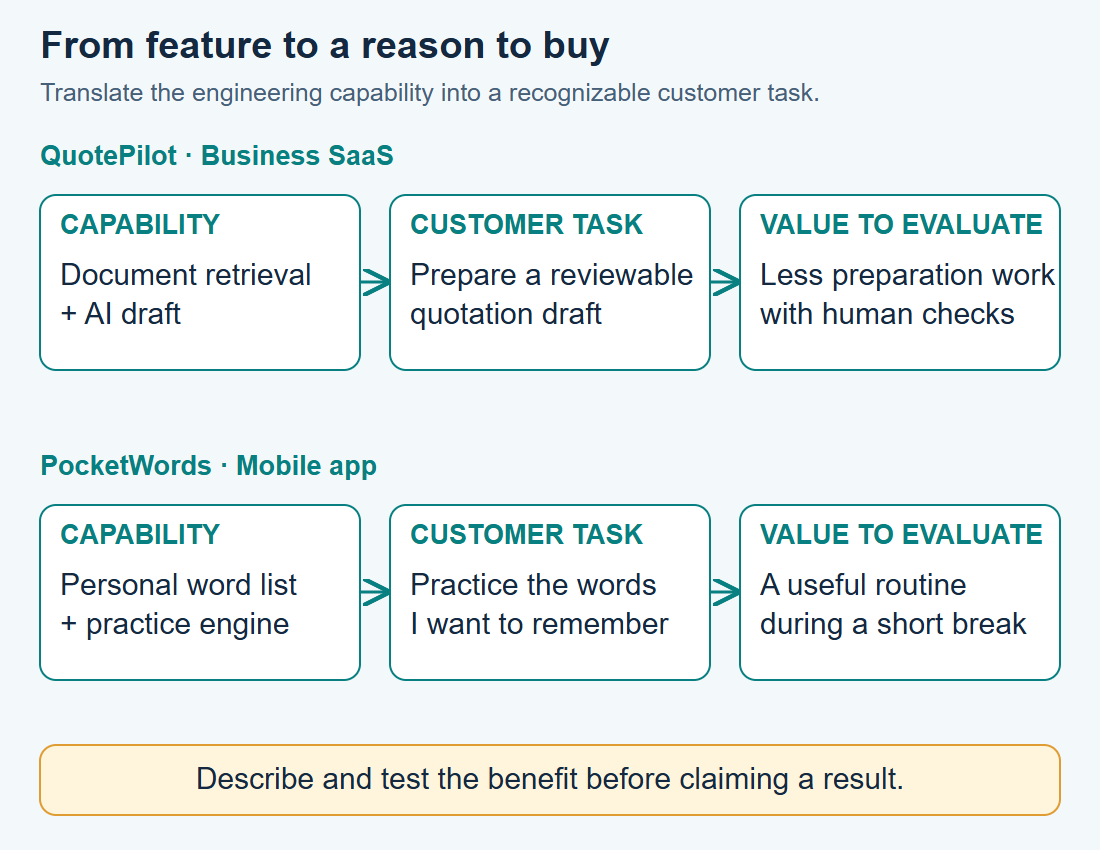
A simple translation exercise for SaaS and mobile apps. Select the image to enlarge it; the benefits are hypotheses to evaluate, not measured customer results.
Define an ideal customer profile, or ICP, with observable criteria. For this example: one quotation team, enough recurring requests to evaluate, accessible historical examples, a named process owner and willingness to keep a human review step. “Every company that wants AI” is too broad to guide product decisions or outreach.
Identify the buying roles separately. The quotation specialist uses it. The service manager may sponsor it. Finance may approve spending. IT and security may evaluate integrations and data handling. In a small business, one person may cover several roles.
Write the alternatives down, too: shared templates, a spreadsheet, an existing CRM feature, an internal AI implementation or doing nothing. Your positioning must explain why changing the current process is worthwhile.
4.1 Buying psychology: why an unproven product feels risky
An engineer may think, “The software works. Why does the buyer still hesitate?” The buyer is deciding something broader: “Will this work for me, can I trust the people behind it, and what happens if I am wrong?” A product can be technically sound while leaving those questions unanswered.
Social proof means using other people’s experiences or choices as a signal when evaluating your own decision. A recognizable customer, a detailed review or a colleague’s recommendation can help someone judge an unfamiliar product. Calling buyers “imitators” misses an important point: consulting others can be a sensible way to reduce uncertainty and evaluation effort. It can also create misleading popularity effects.
Muchnik, Aral and Taylor’s randomized experiment found that earlier ratings influenced later ratings on a social-news website. That demonstrates a social-influence effect in that setting; it does not establish a fixed effect on SaaS sales or app purchases. Popularity can influence judgment without proving product quality. Muchnik, Aral and Taylor, 2013
Why “no reviews yet” can become an obstacle
No reviews does not mean a product is bad. It means one familiar source of independent experience is missing. A prospective app user may wonder whether the product is maintained, whether payment is worthwhile and whether the advertised experience is real. A SaaS manager may worry about support, migration work and having to justify an unsuccessful purchase to colleagues.
Northwestern’s Medill Spiegel Research Center reports retail evidence that the presence and characteristics of reviews are associated with purchase likelihood, including important differences between products with no reviews and those with some reviews. Its summary draws on research first published in 2017. Retail findings should not be converted into a universal “first five reviews guarantee growth” rule for software. Medill Spiegel Research Center
Review count is only one signal. Ask whether the review describes a relevant task, how recent it is, what was actually tested and whether the reviewer’s situation resembles yours. A five-star score from a very small sample leaves different questions open from a longer record with detailed feedback. A generic “Amazing product!” provides little help with integration, reliability or actual use.
Vana and Lambrecht’s research found that individual review information mattered beyond the aggregate rating, particularly where it helped resolve product uncertainty. The practical lesson is to seek useful, specific feedback rather than focusing exclusively on an average star score. Their retail study is not a guaranteed conversion estimate for an app or SaaS launch. Vana and Lambrecht, 2021
Why the familiar alternative often wins
Status quo bias describes a tendency to favor the existing option. Samuelson and Zeckhauser documented this in decision experiments and real choice settings. A buyer may continue using a familiar spreadsheet even when a new product looks promising. However, migration, retraining and downtime can also be real costs; reluctance to switch is not automatically irrational. Samuelson and Zeckhauser, 1988
For QuotePilot, explain the transition: what data is needed, who checks the drafts, whether the existing process can continue during evaluation and how the customer can leave. For PocketWords, let a person understand and experience the practice task before requiring extensive setup. A clear next step and a reversible evaluation can address uncertainty more directly than another list of features.
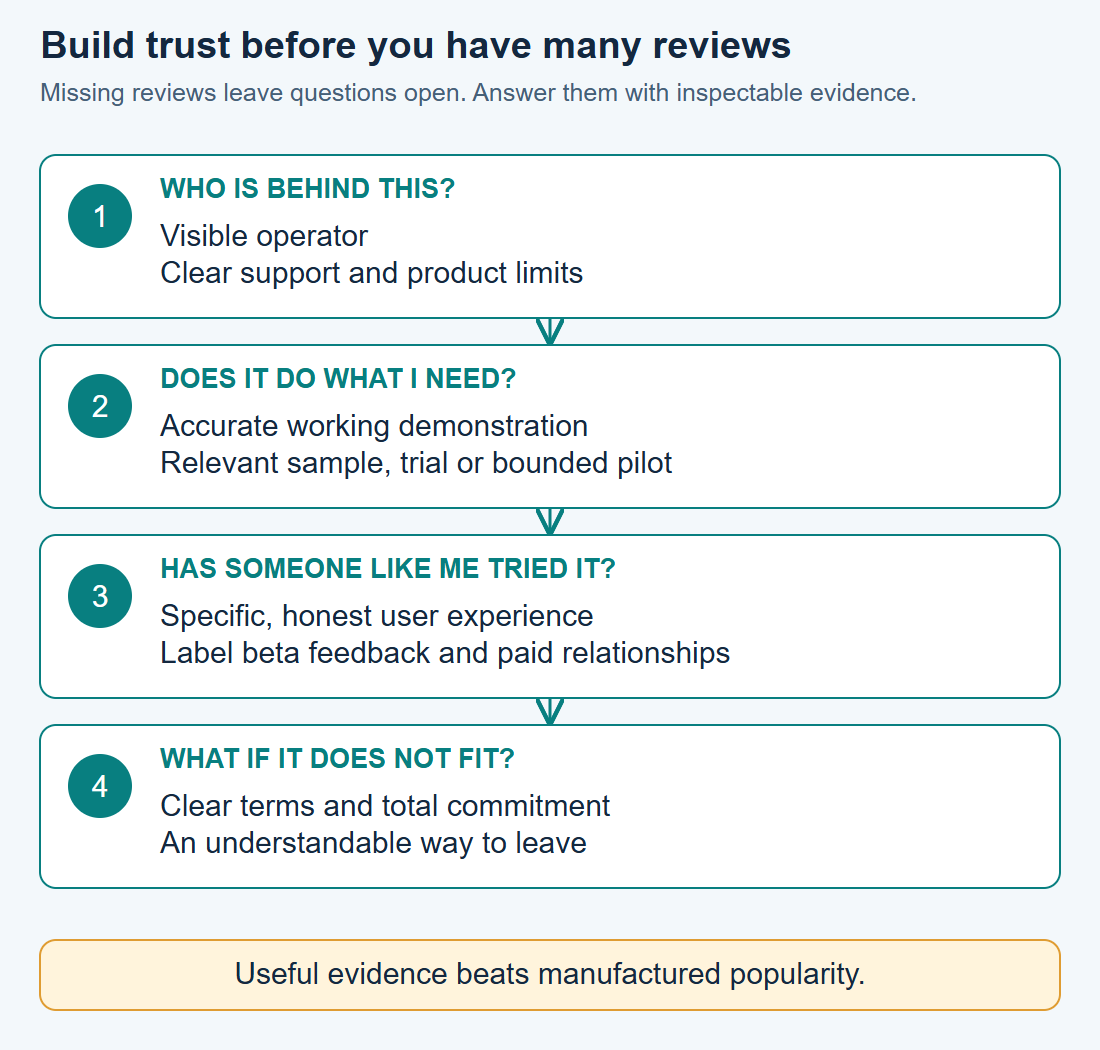
A trust-building checklist for a new product. These are complementary forms of evidence, not a formula that guarantees a purchase. Select the image to enlarge it.
The first-customer problem: how to build trust before you have reviews
You need users to earn credible reviews, but users may want evidence before trying the product. Break that circle by making the first commitment smaller and the evidence more inspectable:
- Show an accurate working demonstration with clearly identified sample data. Separate features available today from plans.
- Explain who operates the product, how support works, what it costs and what its limits are. A visible identity is a trust signal, not a substitute for performance evidence.
- Recruit suitable early users who understand the product’s maturity. Offer a bounded pilot, sandbox or beta appropriate to the risk. Do not call a free tester a paying customer.
- Record what was tested, what happened and what remains uncertain. A useful SaaS case study describes the workflow, baseline, evaluation period, human effort and limitations.
- Ask for honest feedback through the appropriate channel. Obtain permission for public quotations or customer logos and disclose relevant commercial relationships.
For QuotePilot, a first reference might explain the kind of service requests evaluated, the review process and the buyer’s actual experience. For PocketWords, early users can describe whether they completed practice sessions and what confused them. Public beta feedback, a product demonstration and a verified customer review are different types of evidence; label them accurately.
A practical testimonial request is: “What task were you trying to complete, what happened when you used the product, and what should a similar user know before trying it?” Ask neutrally rather than requesting a positive verdict. Never invent reviews, reward a positive rating or screen out dissatisfied users to manufacture an apparently independent reputation.
Some suitable early users may accept uncertainty when the problem matters to them and support is close. Others will sensibly wait for a longer track record. Neither group represents every buyer. Marketing should help people judge fit and risk, not shame them into adopting something new.
4.2 Pressure selling, false promises and outright sales lies
The same human shortcuts that help people navigate uncertainty can be exploited. A seller can replace evidence with pressure, manufacture social proof or make the cost of saying “no” deliberately uncomfortable. These practices exist in personal sales conversations as well as in software interfaces.
Dark patterns are interface and choice-design practices that steer or obstruct decisions in ways that undermine informed choice. The US Federal Trade Commission’s 2022 report documents examples such as concealed charges, disguised advertising and obstructive subscription cancellation. These are documented patterns; the software examples below are illustrative, not allegations against particular vendors. FTC: Bringing Dark Patterns to Light
| Practice | A realistic software-sales example | An honest alternative |
|---|---|---|
| Artificial urgency | A “last chance” discount repeatedly resets, or a salesperson invents an expiring approval | Explain a genuine deadline and what actually changes after it |
| Pressure to bypass evaluation | “Sign now; there is no need to involve IT or compare the terms” | Give the buyer time, written terms and access to the relevant reviewers |
| False capability promises | A planned integration is sold as available, or “fully autonomous” hides mandatory manual work | Demonstrate current capability and label roadmap items and human effort |
| A misleading demo | Only rehearsed success cases are shown while important failure modes are concealed | Use representative examples and disclose evaluation limits |
| Manufactured social proof | Invented testimonials, inflated customer counts or logos implying customers that do not exist | Use permissioned references and accurately distinguish users, testers and paying customers |
| Hidden costs and commitment | A low monthly headline conceals required annual payment, setup fees, usage charges or trial renewal | Show the billing period, total commitment, limits and recurring charges before purchase |
| Cancellation obstruction | Signup takes a moment, but cancellation requires repeated offers, confusing screens or unexplained delays | Make the cancellation path clear and explain access and data handling afterward |
These practices connect directly to the psychology above. Fake popularity borrows other people’s apparent approval. Artificial deadlines reduce time for reflection and comparison. Pressure in a sales call can make refusal socially uncomfortable. Hiding terms makes the immediate offer look simpler or cheaper than the actual commitment. Obstructive cancellation makes leaving harder after the initial decision.
There is an important difference between a genuine constraint and an invented one. A consultant may really have only two available onboarding slots. A subscription may genuinely renew after a clearly disclosed trial. The problem is deception, omission or pressure that prevents a buyer from understanding and freely assessing the offer. The UK Competition and Markets Authority’s published guidance discusses misleading urgency and price-reduction claims; it is useful background on these patterns, not a legal assessment of every SaaS or app offer. CMA: urgency and price-reduction claims
How a buyer can respond without an argument
Ask for the claim in writing, identify the exact product version and plan, and request a demonstration of the promised workflow. For an AI product, ask what the system does automatically, what a person does and how failures are handled. Check the total commitment, usage limits, renewal and exit process before agreeing.
A useful reply is: “Please send the full terms and evidence for that capability. We will decide after our review.” If the seller will not allow a reasonable evaluation, that is relevant information about the proposed relationship. A live counter or confident sales statement is not independent evidence.
What this means for engineers building a business
A difficult question should lead to a precise answer: “That integration is not available today,” “This result required human review,” or “We have three pilot teams, not three paying customers.” When an estimate is uncertain, explain the assumption and the next test. If a promise turns out to be wrong, correct it with the buyer promptly.
Do not evaluate your own marketing only by how many people clicked “Buy.” Inspect whether they understood the commitment, reached the promised value, stayed voluntarily and could leave without obstruction. A coerced purchase or misleading first impression does not establish product–market fit. Trust earned through clear promises and verifiable delivery supports the repeat business this guide is trying to build.
5. Run discovery conversations before increasing production
Ask about the last real occurrence rather than requesting opinions about a hypothetical app:
- “Walk me through the last quotation that took longer than expected.”
- “Which steps required searching, copying, checking or waiting?”
- “How often does this happen, and what happens when it goes wrong?”
- “What have you already tried? Why was that insufficient?”
- “Who owns this process and who would approve a change?”
- “Could we evaluate ten historical cases together, using approved data?”
Record evidence, including contradictions. “Looks interesting” is weak evidence. Access to representative examples, an introduction to the budget owner and a scheduled pilot discussion are stronger signals. They still do not equal a sale.
A useful follow-up is a short written summary: the problem as the buyer described it, the present workflow, the uncertain assumptions and the mutually agreed next action. Ask the buyer to correct it. AI can draft the summary; you remain responsible for accuracy.
When the pain is small, the budget unavailable or the process unsuitable, close the opportunity or agree an appropriate later check-in. A full pipeline of unqualified names hides the problem.
6. Modern sales and marketing methods for software products
The following methods are practical recommendations, not a claim that every channel has proven superior returns. Their effectiveness depends on audience, price, sales cycle and execution. Begin with one primary acquisition route and one supporting route.
Start with the customer’s question, then choose the channel
A channel is a route through which people encounter you: search, LinkedIn, an app store, a partner or a newsletter. A campaign connects a defined audience, a message, a useful piece of content and a next step over a chosen period. Buying advertising before deciding those things is like adding servers before understanding the workload.
Positioning answers “Who is this for, what does it help them do, and why choose it over their current alternative?” Messaging turns that answer into words and demonstrations people understand. A value proposition is the specific benefit you offer. A call to action, or CTA, tells an interested person what to do next: try a sample, install the app or arrange a workflow review.
For QuotePilot, “AI document automation” describes technology. “Prepare a reviewable quotation draft from a service request” describes a job the buyer recognizes. For PocketWords, “AI-powered adaptive learning” is less concrete than “Practice vocabulary from your own word list during a short break.” Only make the latter claim if the product actually supports it.
Marketing also has two different jobs. Demand creation helps suitable people recognize a problem or a better approach before they search for a product. Demand capture helps people who are already looking find and evaluate your offer. A short educational video can do the first; a relevant search result or store listing can do the second. A newly invented category may need more education than a familiar utility.
The arrows organize the work; real buyers can revisit stages, ask colleagues or switch channels. This is a planning sketch, not measured conversion data.
6.1 Founder-led sales: learn directly from early buyers
The founder conducts discovery, demonstrates the product and helps define the first pilots. This fits an early product, a complex workflow or a higher commitment purchase. A founder can resolve technical uncertainty and change the offer quickly.
Start with a small list of relevant organizations and introductions through existing professional relationships. Use a message about a specific workflow, not a generic AI pitch. Track qualified conversations, agreed next steps, paid pilots and reasons for losing. When a pattern repeats, document it so another person can sell it.
Avoid turning every meeting into unpaid bespoke development. Separate learning, a bounded paid pilot and additional implementation work.
For a deeper introduction to prospect selection and first conversations, Stripe Atlas provides a practical guide to winning initial B2B customers. It is practitioner guidance rather than a controlled comparison of sales methods. Stripe Atlas: Your first 10 customers
6.2 Product-led growth: let users experience value
Product-led growth, or PLG, means the product itself helps acquisition, activation or expansion. It fits software that users can try safely and understand quickly: a developer utility, a focused analytics tool or a lightweight collaboration app.
Offer a sandbox with sample data, a guided task and a clear result. For QuotePilot, that might mean uploading a supplied fictional request and inspecting a source-linked draft. Define activation as completing and reviewing that draft, rather than merely creating an account. Measure time to first value, activation rate and paid conversion among mature trial cohorts.
A free tier needs cost controls, especially when every AI request costs money. Limit expensive usage, show limits clearly and prevent trial onboarding from requiring production credentials. When security reviews or integrations are necessary, combine self-service evaluation with human assistance. That combination is often called product-led sales.
ProductLed’s 2026 explanation similarly places self-service and sales assistance on a spectrum, with human help useful when buyer requirements are complex. This supports matching the buying experience to the product; it is specialist guidance, not proof of a universal conversion uplift. ProductLed: The PLG spectrum
6.3 Account-based marketing: work with a small named market
Account-based marketing, or ABM, coordinates marketing and sales around selected companies. It fits a niche product with substantial contract value and several buying roles. It is usually excessive for a low-price utility sold to individuals.
Choose, for example, twenty firms with the relevant workflow. Research their public operating context. Prepare a role-specific demonstration and a short business case. Work toward introductions to the process owner, user and technical reviewer. Measure engagement and progress at company level; five contacts at one company are not five independent opportunities.
Personalization should reflect a real business reason to talk. AI-generated compliments and superficial company-name substitutions add little value. Use appropriate contact permissions and channel rules; avoid automated bulk outreach as a substitute for relevance.
6.4 Search and AI discovery: publish answers buyers can verify
Traditional search engine optimization, or SEO, remains useful. Answer engine optimization (AEO) and generative engine optimization (GEO) refer to efforts to make material understandable and discoverable in AI-mediated answers. These labels describe changing practices; they do not guarantee that an AI service will cite you.
Build pages around specific decisions: “How to evaluate AI quotation software,” “Human review and critical errors,” “QuotePilot versus templates” and “Data handling and integration requirements.” Put a direct answer near the top, then show examples, limitations, evidence, authorship and an update date. Use meaningful headings and accessible HTML. Keep factual product information consistent across your site and public listings.
Google’s own documentation says established SEO practices remain relevant to its AI features and that special additional optimizations are unnecessary for inclusion. Start with useful, accessible, indexable content. That guidance concerns Google Search; other AI services have their own discovery behavior. Google Search Central: AI features and your website
The buyer-research shift observed by Semrush makes this worth testing. It does not justify abandoning search, referrals or direct conversations. Semrush study
Track qualified enquiries and ask buyers how they found you. You can record whether a fixed set of buyer questions mentions your product in selected AI services, with dates and context. Treat that as a noisy visibility observation, not a stable ranking or a causal revenue measure.
6.5 Expert content and demonstrations: make your reasoning useful
Create an evidence-rich article, a three-minute workflow video, a live teardown or a small calculator. Explain a buyer’s decision, including when your product would be unsuitable. Technical content becomes commercial when the intended buyer understands its relevance and the next step.
Edelman and LinkedIn’s 2026 public findings emphasize original thinking, credible evidence and useful ideas shared in private buyer conversations. This supports creating material that a champion can pass to colleagues; it does not prove that publishing frequently will cause sales. Edelman–LinkedIn report
For QuotePilot, publish an anonymized evaluation example with clearly permitted data, measured preparation time and error categories. Until a real customer approves a case study, label demonstrations as fictional or synthetic. Repurpose the same evidence into a LinkedIn post, short video and sales handout; each should lead to the relevant demo or pilot page.
What to publish when you have never done content marketing
Content marketing means publishing useful material that helps a relevant audience understand a problem or make a decision. Start with questions you hear in customer conversations. One carefully demonstrated answer can be more useful than a calendar full of generic AI commentary.
For a first LinkedIn post about QuotePilot, use a simple sequence: describe the manual task; show one concrete example; explain what the tool drafts and what a person checks; offer a sample walkthrough. A possible opening is “The difficult part of a service quotation is often finding the right scope information, not typing the final document.” Follow it with a synthetic example and a question about the reader’s workflow. Do not invent customer savings or imply a demonstration is a customer case study.
For PocketWords, show a short screen recording: a person adds three words, completes a practice round and sees what to review next. Give the clip a clear opening such as “Make a quick practice session from the words you keep forgetting.” The viewer should understand the benefit before seeing a feature list. Add captions so the explanation works without sound.
Use a format ladder: a short clip introduces the problem; a longer demonstration answers “How does it work?”; a clear product page answers “Is this for me?”; a trial or conversation answers “Will it work in my situation?” Adapt each asset to the channel rather than pasting the same text everywhere.
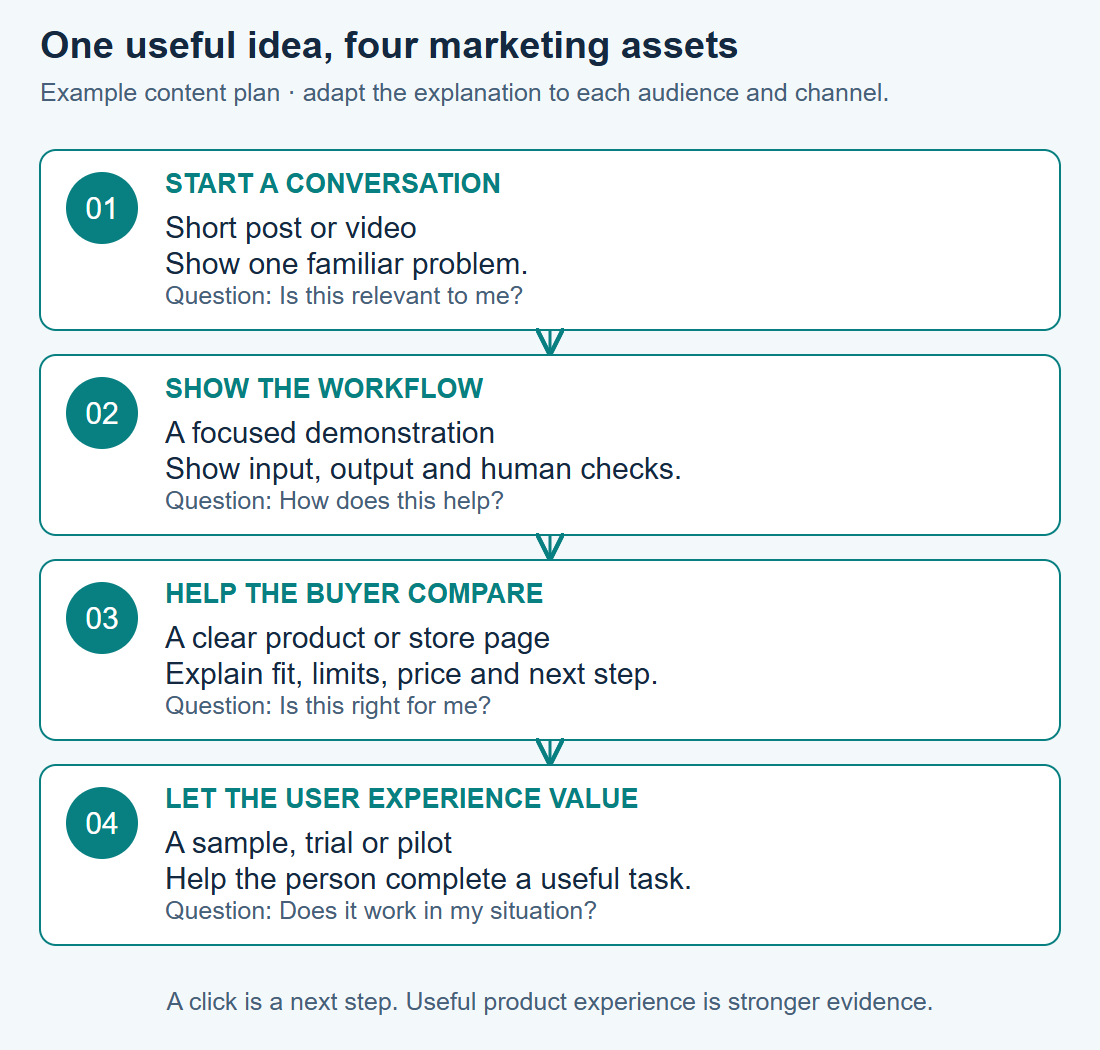
One useful idea can support several assets, each answering a different buyer question. Select the image to enlarge it.
HubSpot’s 2026 report highlights short-form video, content adaptation and AI-assisted workflows. These are survey observations across different businesses; they do not establish that a particular format will produce the best return for your product. HubSpot: 2026 marketing report
Build recognition through people with relevant expertise
A recognizable brand gives buyers consistent cues: the same product name, a clear promise, a coherent visual appearance and a repeated point of view. This helps a buyer connect a useful post, a later search result and a product demonstration. A logo alone cannot establish trust; reliable explanations and product experience have to support it.
An expert creator is someone whose audience values their judgment on a particular topic. For B2B software, that might be a maintenance specialist or industry consultant rather than a celebrity. For a vocabulary app, it could be a language teacher demonstrating a real learning routine. Audience relevance matters more than the largest follower count.
LinkedIn’s September 2026 guidance emphasizes subject expertise and audience fit in B2B creator partnerships. It is platform guidance from an advertising provider, so use it as a method to evaluate rather than a sales guarantee. LinkedIn: B2B creator marketing
Start with a joint demonstration, an interview or an honest product walkthrough. Agree the audience, deliverable, disclosure of any commercial relationship and a way to inspect downstream interest. A sponsored endorsement without real product understanding can damage the trust you are trying to build.
6.6 Communities, integrations and partners: reach an existing audience
For developer products, documentation, runnable examples and helpful participation in relevant communities can build confidence. Answer real questions and disclose your connection when mentioning your product. Stars and downloads are intermediate signals; inspect activated use and paying retention.
For workflow software, a specialist consultant, integrator or complementary software provider may already serve your target customer. Test a joint demonstration or one referred pilot. Agree who owns implementation, support, customer communication and any referral arrangement. Track qualified referrals, paid conversions and contribution after partner costs. A marketplace listing alone is not a distribution strategy.
6.7 Paid demand capture: test existing intent
Paid search can help when buyers already search for the problem and you have a relevant landing page. Begin with a bounded experiment, carefully chosen queries and a single next step. Broad “AI software” traffic may be expensive and poorly qualified.
Measure downstream results: qualified evaluations, paid customers, retained contribution and acquisition cost. An ad platform’s attributed conversions can include customers who would have arrived anyway. Google’s measurement guidance describes using incrementality experiments alongside attribution; use a credible holdout design where volume and tooling permit it. Google measurement guidance
With only a few customers, acknowledge uncertainty and inspect individual buying journeys. A small channel comparison cannot establish statistical superiority.
6.8 Activation and retention: help customers succeed after signup
Acquisition becomes wasteful when users cannot reach value. Guide the first task, explain the next useful action and offer help when the workflow stalls. Use relevant in-product guidance and appropriately permissioned messages. Remove unnecessary onboarding steps before adding more reminders.
Measure activation, continued use, renewal and expansion by cohort. A cohort is a group that started in the same period or through the same route. Ask for referrals after demonstrated success. Retention is part of the commercial system because satisfied customers can renew, expand and recommend you.
6.9 App store optimization: turn discovery into a useful first session
App store optimization, or ASO, improves how an app is found and understood in its store listing. It combines relevance to a user’s search with a page that communicates the product accurately. A listing that attracts the wrong people can increase installs while reducing useful engagement.
For PocketWords, choose a specific audience and language first: for example, adults who collect vocabulary but struggle to practice it regularly. Describe the actual learning task in the app’s title, subtitle or description where the store permits it. Avoid inserting unrelated popular keywords. An icon helps recognition; screenshots should make the experience understandable.
A beginner-friendly screenshot sequence might be: “Save the words you want to remember,” “Practice a short session,” and “Return to the words that need attention.” Show genuine interface screens that support those statements. Localize examples and wording for the intended market, not just the interface labels.
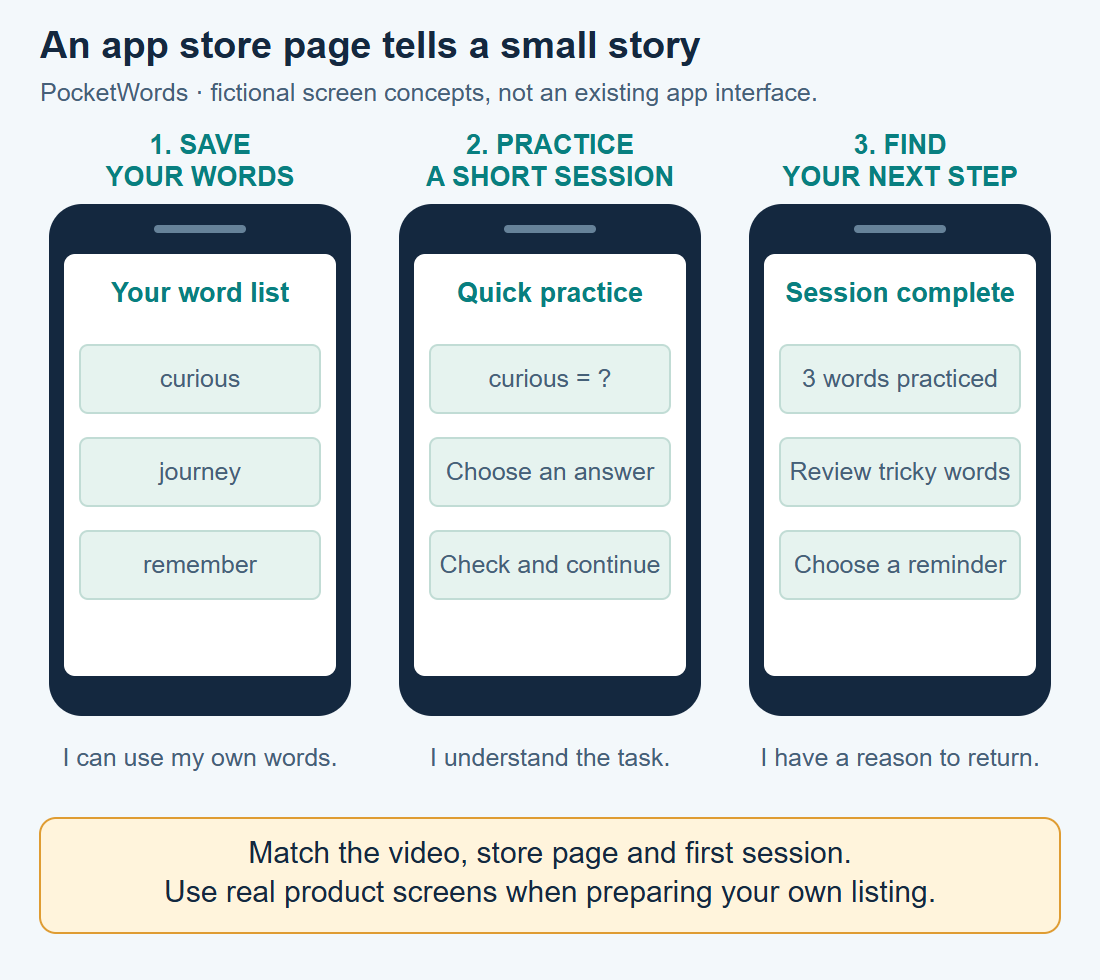
Illustrative screen concepts for the fictional PocketWords app. They show a storytelling pattern, not a finished interface or actual app screenshots. Select the image to enlarge it.
Apple offers custom product pages to present an app differently for particular audiences or campaigns. Its product page optimization feature separately supports testing alternative product-page assets. A custom campaign page is not automatically an A/B test: audiences coming from different campaigns can differ. Apple: custom product pages, Apple: product page optimization
Google Play’s store listing experiments can test graphics and, for localized experiments, descriptions. Google recommends changing one asset at a time and provides statistical result guidance. A result that needs more data is a reason to keep learning, not to declare a winner from a small early difference. Google Play: store listing experiments
After the install, deliver the promise quickly. If the campaign shows a short practice session, onboarding should help someone complete that session before demanding extensive setup. Explain trial and subscription terms clearly before commitment. Ask for product feedback and respond to legitimate reviews; avoid fake, rewarded or filtered ratings. Apple describes its rating and review practices in its developer guidance.
6.10 Lifecycle messages and growth loops: create a reason to return
A funnel describes the sequence from discovery to use and purchase. A growth loop describes how successful use can help create another useful visit or introduce another person. For example, an optional shareable vocabulary list might introduce a friend to PocketWords. The shared list must be useful in its own right; forcing invitations before practice adds friction.
For QuotePilot, a successful pilot can lead to a reference conversation, a case study with permission or an introduction to another service team. For PocketWords, a useful first week can lead to continued practice and an honest recommendation. Build these requests around demonstrated value.
Lifecycle marketing means communicating according to a customer’s stage. A new SaaS user may need help importing a sample; an active team may need a useful integration guide; an app user may want a chosen practice reminder. A nurture sequence is a short series of relevant messages that helps someone understand or evaluate the offer over time.
An illustrative sequence for someone who requested a SaaS demo is: send the promised walkthrough; explain one common implementation question; offer a discussion of their workflow. Do not turn a requested asset into an indefinite stream of unrelated messages. For an app, use optional reminders at a chosen time and make them easy to change. Measure completed valuable actions after messages, alongside unsubscribes or notification opt-outs.
6.11 Measure a customer journey, not just an audience
An impression means a platform reports showing something. Reach usually counts people or accounts reached, according to that platform’s definition. A click means someone followed a link. A conversion is the action you decide matters, such as a completed demo request or subscription purchase. Always name the action and denominator: “conversion rate” by itself is ambiguous.
For a SaaS product, inspect relevant visits → qualified enquiries → completed evaluations → paying organizations → renewals. For a mobile app, inspect store visits → first-time installs → first valuable session → continued use → paying subscribers. These are different units: organizations, people, installations and subscriptions should not be mixed in one calculation.
Retention means people or customers continue using or paying for the product over a stated period. Define it precisely. For example, day-7 app activity might mean users from a first-open cohort completed a practice session on the seventh day. “Returned at any point in the first week” measures a different behavior. Keep the definition fixed when comparing cohorts.
Use campaign links or identifiers where supported to distinguish sources, and add a simple “How did you hear about us?” question in appropriate contexts. Someone may discover you in a video, receive a colleague’s recommendation and later arrive through search. Attribution allocates credit to observed touchpoints; it does not reveal every influence or prove what caused the purchase. Mobile privacy and platform reporting also limit the detail you can observe.
For low volumes, inspect actual user journeys and conversations before building a complex dashboard. Improve the weakest useful step. If installations rise but first-session completion falls, check whether the campaign promise matches the product and whether onboarding works. If trial activity is strong but purchases are weak, investigate value, price, terms and trial timing before buying more traffic.
7. Two beginner campaigns: SaaS and a mobile app
Here is a focused first campaign for fictional QuotePilot. These are proposed activities, not achieved results.
| Element | Concrete execution | Decision signal |
|---|---|---|
| Audience | Maintenance service managers with recurring manual quotations | Recognizable problem and accessible workflow |
| Core asset | A page showing one request, draft, sources and human corrections | Buyer can explain the outcome back to you |
| Primary channel | Founder conversations through relevant introductions | Qualified next steps and paid pilot discussions |
| Supporting channel | Practical article plus a short demonstration shared professionally | Relevant enquiries and internal sharing |
| Offer | Two-week paid evaluation with agreed cases and acceptance criteria | Buyer commits budget, time and a process owner |
| Follow-up | Send the agreed summary and one relevant proof asset | Buyer resolves an identified uncertainty |
| Review | Inspect results after a fixed learning period | Continue, revise the offer or stop |
A landing page can follow this simple structure: who it helps; the costly workflow; one visible example; what changes; evidence and limits; evaluation or pricing terms; common objections; one clear call to action. Offer “Review your quotation workflow” when a conversation is necessary, or “Try a sample request” when self-service is realistic.
An illustrative, manually reviewed introduction might say:
I’m researching how maintenance teams prepare quotations from service requests. We have built a small tool that drafts a quotation with links back to the request, with a person reviewing the result. If this is a recurring issue for your team, would comparing your current workflow with a sample demonstration be useful?
Use the recipient’s real context when you know it. Do not invent a relationship, a measured saving or a claim that you have inspected their internal process.
Example A: a first SaaS campaign for QuotePilot
Imagine you have a working prototype but no customers. During the first week, speak with a handful of maintenance managers about their last quotation workflow. Use the language they use to describe the problem. Then create one page with the offer and a short synthetic demonstration.
Your first content theme could be “Where quotation preparation loses time.” Publish a useful explanation, a screen-recorded example and an invitation to review the workflow. A small online workshop can walk through one request, let participants ask questions and explain the pilot. A webinar is simply an online presentation with interaction; it needs a useful topic and the right participants, not elaborate production.
On the landing page, replace a feature-led headline such as “Next-generation AI-powered quote management” with a task-led explanation: “Turn a service request into a quotation draft your team can review.” Underneath, show the input, a draft with source references, the required human checks and the pilot offer. A landing page is the focused destination for a campaign; it should help the visitor take the promised next step.
Route interested people to the relevant next step. A person who only wants to understand the workflow can watch the demo without booking a call. A manager who wants to evaluate fit can request a discussion. Record which problem they describe and what they agree to do next. If nobody recognizes the pain, revise the target or offer before adding features.
Example B: a first mobile campaign for PocketWords
For the app, use a different route. Recruit a small group of adult learners for usability feedback, then prepare an accurate store listing. Create a short vertical video that shows one complete practice task. Place it where those learners already seek advice, such as a suitable teacher’s audience or a relevant community that permits product demonstrations.
Keep the promise consistent from video to store page to first session. A clip about practicing a personal word list should lead to a page and onboarding experience about that task. The first screen should not suddenly present an unrelated “AI learning platform” pitch.
Suppose a campaign produces 1,000 store-page visitors, 200 first-time installs, 80 people who finish a first practice session and 10 paying subscribers after a stated evaluation period. These fictional counts imply 20% visitor-to-install conversion, 40% install-to-activation and 5% install-to-paid conversion. They do not tell you whether subscribers will renew or whether the campaign is profitable.
If the first session is confusing, improve that experience before increasing paid distribution. If usage is strong, test one listing or creative change at a time with enough data. When working with several creators, compare activated and retained users, alongside campaign costs, rather than declaring the largest-view video the best campaign.
A small experiment brief you can reuse
Write down the audience, hypothesis, message, asset, channel, next step, spending limit, evaluation period and success measure. For example: “We believe adult learners who collect vocabulary will understand our app better when the first screenshot shows a personal word list. We will test that screenshot against the current one and evaluate the store experiment’s result, then check downstream activation.”
This resembles an engineering experiment: the hypothesis is explicit and the observed result may contradict it. With insufficient traffic, start with interviews and observed usability sessions rather than claiming statistical confidence. Keep a short record of what changed, what happened and what you will try next.
8. Sell a measurable pilot and a buying decision
A pilot should answer a decision, not create an indefinite experiment. Agree the workflow, sample, baseline, owner, duration, fee, costs, access, success criteria and the date of the final review. Specify what happens if the results disappoint.
For QuotePilot, compare baseline and assisted preparation on an agreed representative set. Count human review time and corrections. Use a held-out evaluation set where possible; a polished demonstration on examples used during development is weak evidence of general performance. Record critical errors separately from cosmetic edits.
An illustrative acceptance proposal could require a material median preparation-time reduction, zero observed critical pricing or scope errors in the agreed sample, and an acceptable review process. Agree the actual thresholds with the buyer. Zero observed errors in a finite pilot does not prove zero future risk.
Prepare a small buyer evidence pack: result summary, complete cost assumptions, data flow, model/provider dependencies, human review boundaries, support approach, integration effort and exit/export options. This gives an internal champion material to discuss with finance and IT.
Pricing should reflect the buying process and your cost exposure. A paid pilot can cover evaluation work; a subscription can cover ongoing access; usage pricing can reflect variable AI demand. Outcome-based pricing requires a verifiable outcome and agreed responsibility for external factors. No pricing model removes the need to calculate contribution after real delivery costs.
9. Connect marketing to the buying process
BPMN, Business Process Model and Notation, describes the business workflow. The diagram below is a simplified internal process with two lanes. It distinguishes deciding whether an opportunity is qualified, agreeing a paid pilot and making a rollout decision. Customer conversations occur inside the activities; this is not a complete buyer–seller collaboration model.
The download contains editable BPMN 2.0 XML and diagram interchange data. It is a non-executable documentation model. The “No” paths terminate the current opportunity; re-entry requires a new agreed review.
10. Understand your acquisition economics without reading code
Customer acquisition cost, or CAC, answers “What did it cost us to win one new paying customer?” Include relevant advertising, tools, sales and marketing labor and allocated partner costs. A founder’s unpaid time is still an economic cost. Use a consistent cost definition when comparing channels.
CAC = acquisition cost / new paying customers. Costs and customers must belong to a comparable, sufficiently mature acquisition cohort. This month’s spending may generate sales later; dividing it by unrelated customers who happen to buy this month can mislead you.
Monthly contribution is the recurring revenue left after variable delivery costs. It is not profit: fixed overhead, taxes and other costs remain. For AI software, include inference, hosting, recurring review and support where they vary with usage. Acquisition payback asks how many months of that contribution are needed to recover CAC. An extended calculation also includes onboarding cost minus any onboarding fee.
| Fictional SaaS calculation | Base case | Stress case |
|---|---|---|
| Qualified evaluations | 30 | 30 |
| New paying organizations | 6 | 3 |
| Acquisition cost | €6,000 | €9,000 |
| CAC | €1,000 | €3,000 |
| Monthly subscription per organization | €500 | €500 |
| Monthly variable cost per organization | €150 | €300 |
| Monthly contribution per organization | €350 | €200 |
| Net onboarding cost per organization | €300 | €300 |
| Payback including net onboarding | 3.71 months | 16.50 months |
The base case pays back €1,300 of acquisition and net onboarding cost through €350 of monthly contribution: €1,300 divided by €350 is approximately 3.71 months. The stress case needs to recover €3,300 through €200 per month. This comparison explains why a campaign with some sales can still be commercially unattractive. It assumes customers remain and pay throughout the payback period; actual renewal, collection timing and cash availability matter.
For the mobile example, cost per install (CPI) is a different metric. If €300 of media spend produces 200 attributable installs, media-only CPI is €1.50. If ten of those users become paying subscribers, media-only acquisition cost per payer is €30. Add creative production, labor and other acquisition costs to calculate a broader CAC. Do not compare €1.50 per install with a SaaS CAC per paying company.
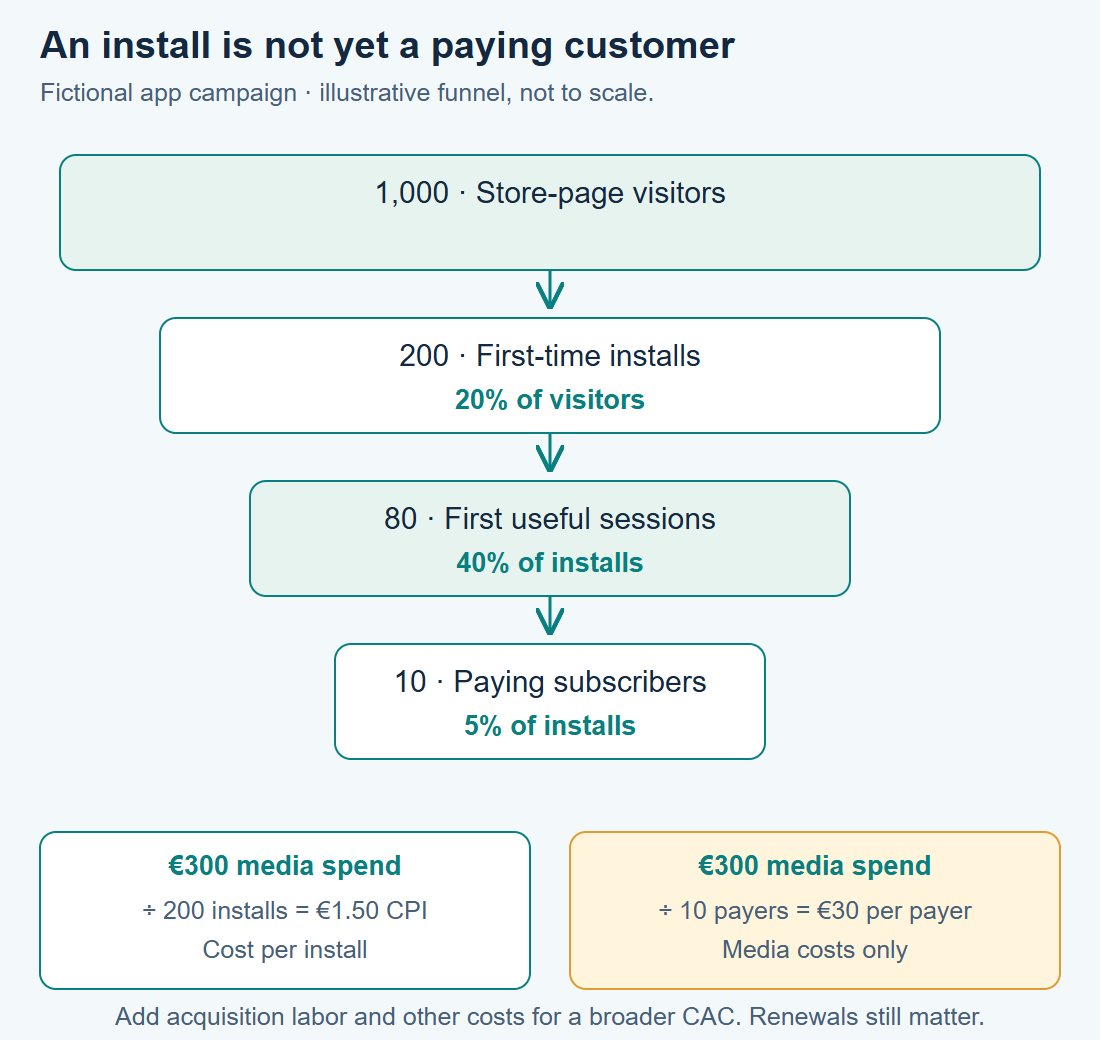
The percentages use the stated denominators: visitors for install conversion, installs for activation and paid conversion. All numbers are fictional; the two cost examples include media spend only. Select the image to enlarge it.
If an app subscription brings €6 in monthly gross revenue, you cannot treat the entire €6 as contribution. Deduct applicable store or payment charges, refunds and variable service costs using your actual terms. A first payment is not lifetime value: renewal and cancellation determine what the customer contributes over time. No universal “good CAC” fits both a business SaaS product and a consumer app.
The examples above use fictional numbers. They are explanations, not Homann Software results or market benchmarks. With no paying customers, CAC is undefined; with zero or negative recurring contribution, recurring acquisition payback is undefined.
For readers who want to inspect the arithmetic, the optional Sales and Marketing Lab contains a small Python model, a worksheet, editable BPMN and UML diagrams and instructions. All 20 regression test methods passed on Python 3.13.14, including an independently extracted reader package. You can understand and apply the marketing guidance without opening the code. The lab checks calculations, not market demand or future sales.
11. Use AI in your commercial workflow with a clear role
AI can help summarize approved discovery notes, compare recurring objections, draft role-specific explanations, suggest content outlines and adapt a verified demonstration into several formats. Keep source evidence available and review each commercial claim.
A useful prompt is: “Using only these approved notes, list the customer’s stated problem, supporting quotations, open questions and agreed next step. Label inferences. Do not invent metrics, budget or commitment.”
Let deterministic software calculate prices, margins and metrics. Let people approve promises, sensitive disclosures and customer-facing statements. Before using customer material with an AI service, establish the appropriate handling and permissions. Use synthetic examples for public demonstrations until real data and publication rights are agreed.
Automating an irrelevant message sends irrelevance faster. Automating a useful internal step can release time for customer conversations. Measure whether your assistance improves the workflow rather than counting generated content.
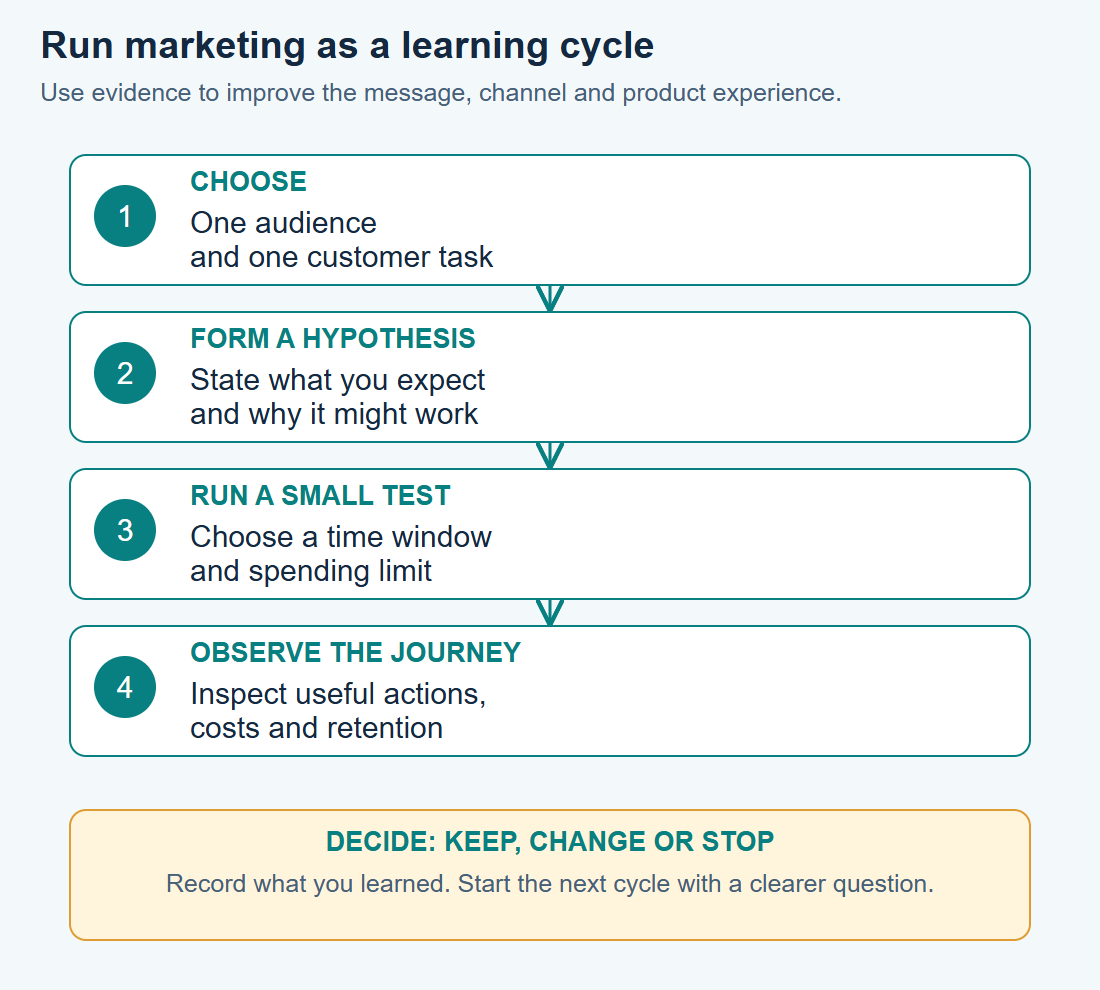
A practical engineering-style rhythm for marketing experiments. Select the image to enlarge it.
12. Your first 30 days
These are learning targets, not sales guarantees. A longer enterprise buying cycle may not produce a contract within a month.
| Period | Work | Tangible output |
|---|---|---|
| Days 1–7 | Choose one customer profile; conduct initial discovery; inspect the existing workaround | A problem statement, buying-role map and explicit unknowns |
| Days 8–14 | Build a narrow demonstration and a clear offer; seek further buyer feedback | One landing page, sample workflow and draft pilot terms |
| Days 15–21 | Test one primary channel and a supporting proof asset; track agreed next steps | Qualified opportunities and objections, including disqualifications |
| Days 22–30 | Seek a bounded paid evaluation; review acquisition costs and learning | A pilot decision or evidence-based revision of the offer |
If you find yourself building features to avoid an uncertain conversation, schedule the conversation before the next feature. Keep improving engineering quality where evidence shows it matters. The objective is a business in which the right customers can discover, evaluate, buy and continue using software that delivers a valuable result.
Homann Software’s Learning Hub connects software engineering, software and systems architecture, and AI. Applying that engineering discipline to customer acquisition means making commercial assumptions explicit, testing the next uncertain step and learning from real outcomes. Explore the Learning Hub
Sources and research notes
Primary publishers and research owners were consulted on 10 November 2026. The article combines recent 2026 observations with established commercial methods. Methods are recommendations to test; none is presented as a guaranteed growth technique.
Atlassian: AI is making developers faster. It’s also exposing what’s broken in software delivery, 20 October 2026. Self-reported developer experience; no universal causal productivity estimate.
Semrush: How AI tools shape the B2B buying process, 8 July 2026. US survey, fielded March–April; findings restricted to AI-using respondents. Publisher sells marketing software.
Forrester: The State of Business Buying, 2026 — public research release, 21 January 2026. Public summary consulted; full paid report not reviewed.
6sense: 2026 B2B Buyer Experience Report. Public 2026 report; consulted without asserting a verified exact publication day. Publisher sells revenue technology. Cross-year findings are not a controlled test of an intervention.
Edelman–LinkedIn: 2026 B2B Thought Leadership Impact Report. Public summary on thought leadership, discovery and private buyer conversations; not a causal test of a campaign.
Google: Rethink ROI with AI-powered measurement. Supporting measurement guidance; Google is an advertising platform provider.
Homann Software. Current Learning Hub scope and site context.
Stripe Atlas: Your first 10 customers. Practitioner guidance on early B2B sales, prospect qualification and conversations.
ProductLed: What Are the 3 Types of Product-Led Growth?, 2026. Specialist guidance on selecting self-service or sales assistance; not causal performance research.
Google Search Central: AI features and your website. Official guidance for Google Search inclusion; not a guarantee of visibility.
HubSpot: 2026 state of marketing. Cross-industry marketing survey; qualitative themes used, not a promise of channel ROI.
LinkedIn: How B2B creator marketing builds buyer trust, 28 September 2026. Platform guidance on expertise and creator relevance.
Apple: Custom product pages and product page optimization. Official descriptions of separate campaign-page and testing capabilities.
Google Play: Run A/B tests on your store listing. Official experiment guidance.
Apple: Ratings, reviews, and responses. Official review guidance.
Muchnik, Aral and Taylor: Social influence bias: a randomized experiment, Science, 2013. Social-news rating experiment; not a software-sales experiment.
Medill Spiegel Research Center: How online reviews influence sales, public summary dated 4 December 2025, discussing findings first published in 2017. Retail evidence; numerical uplifts are not transferred to SaaS or apps.
Vana and Lambrecht: The effect of individual online reviews on purchase likelihood, Marketing Science, 2021. Public abstract consulted; retail context.
Samuelson and Zeckhauser: Status quo bias in decision making, 1988. Public abstract consulted; established behavioral research, not a current software benchmark.
FTC: Bringing dark patterns to light, September 2022. Official summary of documented deceptive design patterns.
CMA: Using urgency and price reduction claims online, 2023. Published UK guidance used to explain patterns, not to make a jurisdiction-wide legal assessment.
All graphics are original. The feature image is an AI-generated conceptual illustration. The capacity sketch, marketing journeys and business numbers are illustrative. The BPMN documents the internal SaaS pilot process; an optional UML diagram documents the downloadable economics model.